You know how there seem to be two unofficial Chinatowns in Auckland, the more raved about one on that stretch of Dominion Road by the Balmoral Road intersection, and the other in Meadowlands, out Howick way? Those places make sense to me. They have variety, with different regional cuisines, and cater mainly to the Chinese immigrant population, though more and more other people go there now too.
What I struggle to understand is how the cluster of Korean eateries on Upper Queen Street came to be. All the Koreans I know say they are nothing compared to the flavours of their own mother's kitchen, and to my untrained palate, each one is much the same as the next.
Prior to us having a four-day stopover in Seoul on the way to Europe, these Auckland eateries taught me all I knew about Korean food, for instance:
- bibimbap (비빔밥) is an assortment of vegetables and/or meat on a bowl of rice, served with gochujang (고추장), a chilli paste that you are supposed to stir through it. This is your best bet for a vegetarian meal.
- almost all dishes are spicy and red-looking
- there are buttons on the sides of the tables for summoning the waiters
- there are always complimentary side dishes, from kimchi (김치) to bean sprout salads to slices of boiled egg, though some places make you pay for a top-up
- at Korean BBQ restaurants, such as Faro, you can grill your own dinner, with an extraction fan in the form of a dangling pipe to remove the smoke
We did find these things in Korea, but we also saw plenty of other foods we never knew about.
1) Chicken and Hof
Everywhere we went, we saw signs advertising chicken and hof. Turns out these are popular Korean-style pubs serving fried chicken and draft beer. The theory is that the term
"hof" came from "Hofbräuhaus", the name of a famous brewery in Germany. Apparently,
the first German set foot in Korea in 1832. My Korean friend, however, is convinced that
hof is simply a mispronunciation of hops, the ingredient which gives beer its bitter flavour.
The first such place we went to gave us a novel mix of food. The fried chicken was delicious, with a hint of 5-spice in the coating, while another version was covered in mildly sweet sauce and almond flakes. This was accompanied by a coleslaw with raspberry-flavoured dressing and criss-cut fries, both of which we had previously encountered only at
Carl's Junior, an American chain.
 |
| Fried chicken, one covered in sauce. |
Yet the pub was still very much Korean, and we were served snacks like popcorn (the round mushroom-shaped ones rather than the butterfly-shaped ones more commonly seen in New Zealand) and pickled radish cubes while we waited for the hot food.
 |
| Pickled radish and round popcorm, along with dipping salts and sauces. |
2) Korean Egg Bread (계란빵 gyeranppang)
In cold weather, the Koreans have a street snack called
gyeranppang, literally "egg bread". A lot of people say this is like a pancake or waffle with a whole egg, but it tasted more like a sweet sponge to me, with an egg either inside or on top, shaped into a little loaf. As with most street food, to enjoy it properly, you really need to eat it fresh and hot.
 |
| Road-side stall with a platter of steaming egg bread. |
 |
| Egg bread, now cold and somewhat deflated. |
 |
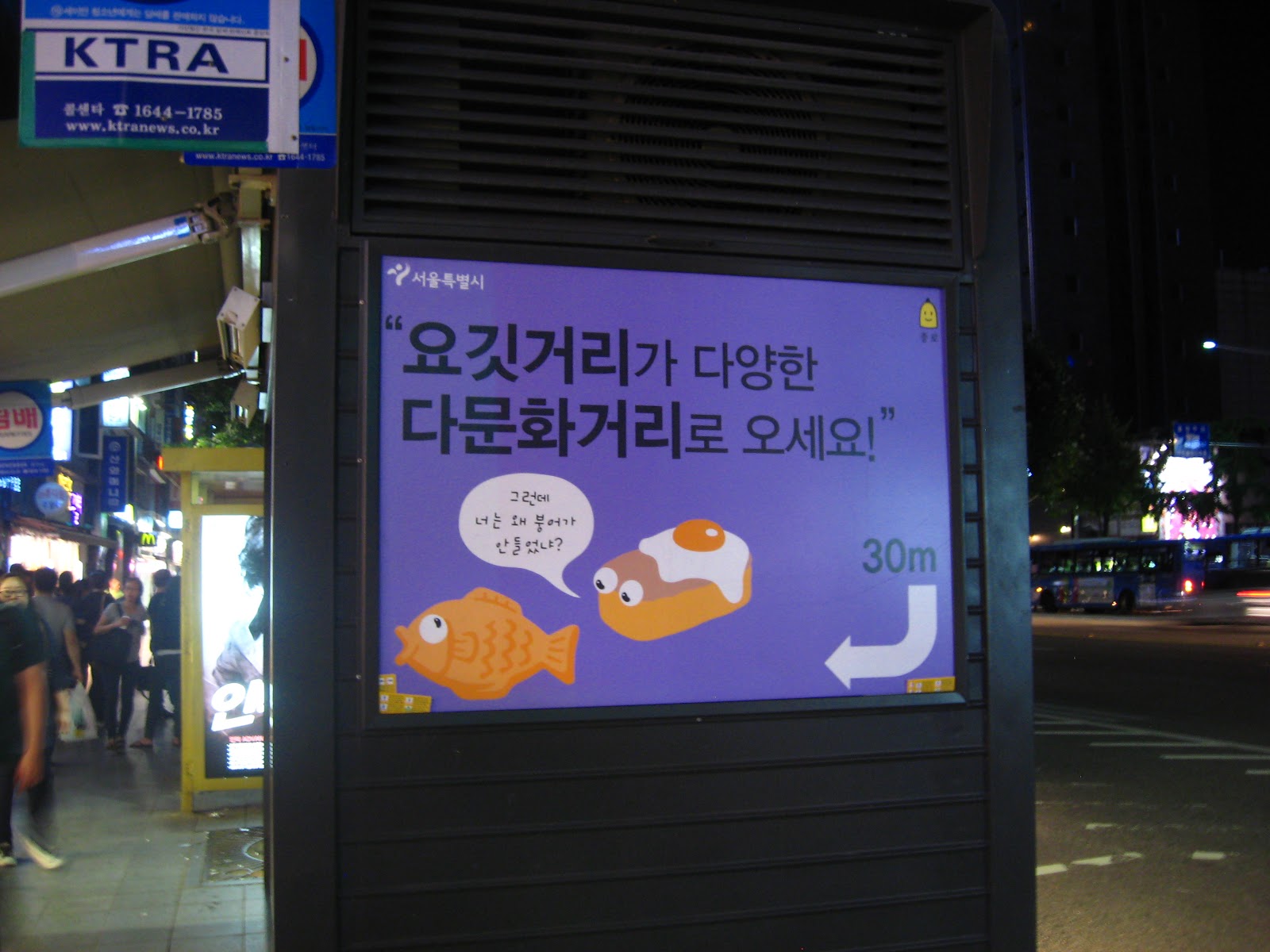
| Cartoon at a bus stop featuring an egg bread and a bungeoppang (붕어빵), a fish-shaped pastry filled with red bean paste, another winter street food. |
3) Really Fresh Street Food
On the topic of street food, they have really fresh stalls in Korea. We stayed close to the Jongno-3(sam)-ga station, and at one of the exits, we even saw live seafood (fish, squid, etc.) swimming in tanks on the side of the street. This is something we might have expected at a high-end seafood restaurant, not at a little eatery by the side of the road!
 |
| Some unusual forms of aquatic life at a little eatery. |
When we ordered a meal (through mime and with help from a youth dining nearby), the stallholder started chopping onions and chillies right then and there. There are of course also stalls where the offerings look like they have been sitting around for a while, but we avoided those, and can safely say we have never had a bad meal in Korea.
 |
| Little eateries line the street by an exit to the jongo-3-ga station. |
 |
| Street stall selling meat skewers. |
In fact, we have not seen so many street vendors before in such a large modern city, because in places like Singapore and Hong Kong, they have all been pushed into hawker centres or actual shops, apparently for hygiene reasons (just like here in New Zealand). And such variety too! Depending on where we went, we saw everything from cooked meals to grilled sweetcorn to filled pancakes to dried cuttlefish.
 |
| Preparing dried chillies. |
4) Coffee Shops
We had no idea coffee was so popular in Korea, but we saw coffee shops everywhere in Seoul, from Starbucks, to places that looked very much like it. Convenience stores and supermarkets also had a large coffee offering.
 |
| Sign for one of many coffee chains. |
 |
| Coffee selection at a large department store. |
4) The Many Varieties of Rice Cakes (떡 tteok)
We've had Korean rice cakes (떡,
tteok) in savoury dishes before, and knew that the chewy white strips tasted much like plain glutinous rice flour. What we weren't prepared for was for the discs served with our tea to taste like that as well, especially since there was a swirl of colour through them. Once you get past the initial surprise at them not being sweet, you can start to taste the sesame oil and subtle rice flavour.
 |
| Rice snacks in a tea house. |
Other rice cakes
are supposed to be sweet, for instance in those colourful balls reminiscent of Japanese mochi, but they were nowhere near as sweet as we expected.
 |
| Variety of glutinous rice cakes in Seoul. |
I wish we had found time to go to the
Tteok Museum, which was just down the road from our hotel. At the time, we had no idea what that was, and had too many other places to explore, but I would have enjoyed learning about the 200 hundred types of rice cake going back 2000 years, and their cultural significance. We could have taken some cooking courses from the
Institute of Traditional Korean Food (situated in the same building) as well.
5) Korean Melons (참외 chamoe)
We saw many fruits and vegetables sold in the streets of Seoul, the most exotic of which was the Korean Melon (though the spherical grapes were pretty unusual too, tasting like what I previously identified as the "fake grape flavour" in Asian fruit jellies). Looking like a yellow courgette, the Korean melon had the flesh colour and juicy firmness of a pear, but the flavour of a sweet rockmelon. It comes in a good serving size too, about the size of a fist. Yum!
 |
| Fist-sized Korean melon. |
6) Expensive Food Gifts
The Korean melons above cost less than NZ$1 each. I discovered the more familiar-looking melons below at an upmarket department store, and I'm not sure if they actually count as food, because really, do people eat these? The rockmelons on the far right, cutely tied in ribbon, cost... *drum roll please*... ₩22,000 (~NZ$24.50) each. The smaller watermelon on the left costs ₩32,800 (~NZ$36.50). As for the large round watermelon on the right? Take a guess: $50, $100? No, that costs an extraordinary ₩245,000 (~NZD$272). That's right, that's over NZ$270! That person you want to please had better really like their watermelon!
 |
| Expensive melons! |
For something a little different, you could buy a large fruit basket for ₩153,000-207,000 (~NZ$170-230), a box of pine nuts for ₩120,000 (~NZ$133), or even splash out on the
most expensive mushroom in the world, the pine mushroom (송이
songyi in Korean; 松茸
matsutake in Japanese), for ₩580,000 (~NZD$644) for the box in the photo.
 |
| Gifts to impress. |
7) Noryangjin Fisheries Wholesale Market
Okay, so this isn't technically a food, but the fish market at Noryangjin is huge, with over
700 stalls over 66,000 square metres! We have never seen so much seafood in one place before, much of it still swimming. And unlike the biggest food market in the world at
Rungis, visitors are welcome. There are also restaurants in the building, where you can eat a fish you have just bought (or the restaurant can purchase one for you downstairs). Fancy a live octopus
á la Oldboy, tentacles still squirming in your mouth? You're in the right place!
We didn't get up early enough to witness the auctions, but we were impressed anyway!
 |
| First glimpse of the Noryangjin Fisheries Wholesale Market. |
 |
| Some of the seafood available at one stall. |
---
We only spent a few days in Seoul, and can only have scratched the surface of the food in Korea. But in that short time, we have already come to realise that what we see in Auckland is only a small subset of Korean cuisine. We have had many delicious meals, but this place definitely warrants a return visit!