Showing posts with label Curious Panda. Show all posts

Sunday, May 24, 2015

3 Places for Intelligent Bites in Auckland

A few days ago, it was announced that New Zealand's cultural treasure John Campbell would be leaving. Carefully timed with the Government's Budget 2015, we learnt that his signature current affairs programme Campbell Live, despite regularly becoming TV3s top-watched show, would be replaced by one with more of an entertainment focus, one that doesn't ask difficult questions.

As a person who simply writes about the fun and non-threatening topic of food, I have a huge respect for caring journalists like him, who help us to see news from a different angle, and fearlessly push to change things for the better. So, while staying on topic, I thought I would share some eateries in Auckland that feed the mind as well.


1) IKA Seafood Bar and Grill

In my last post, I wrote about a restaurant that featured in Metro Magazine's 50 Under $50 list. In part, we gave Ika a try at the urging of Nanogirl, otherwise known as Dr. Michelle Dickinson, a passionate engineer who freely gives her time and money to foster an interest in science, particularly in the young. She was one of a line-up of speakers at a conversation at the restaurant last week, and there is another talk coming up soon on a completely different topic too.

Previous Talk

Table Talk: Beneath the Ponytail: women, work, progress?

Tuesday 19 May – doors open 5 pm, discussion at 6.15 pm
Hosted by Lisa Owen, from TV3’s The Nation, with

  •     EEO Commissioner, Human Rights Commission, Dr Jackie Blue
  •     Senior Lecturer, UofA Engineering School, Dr Michelle Dickinson aka @nanogirl
  •     First Union Secretary, Maxine Gay
  •     Labour Party MP, Jacinda Ardern

Bar open from 5 pm, small & large plates served throughout evening
Showtime 6.15 – 7 pm

Next Talk

“Abba to Gaga: pop music as queer revolution” - an Ika Salon with Dr Kirsten Zemke
(Facebook event here)
Tuesday 26 May 
Dr. Kirsten Zemke is a Senior Lecturer in Ethnomusicology in the Department of Anthropology at the University of Auckland. She famously completed her PhD on New Zealand hip hop in 2000, and has been teaching, and talking, about popular music, race, gender, genre and identity since then. She currently has regular radio spots on bFM and Radio National. 
Despite its sometime silliness, shallowness, sexism and commercialisation, pop music has been quite a radical site for promoting queer identities. Genres of glam rock, disco, and eighties new wave all projected gender fluid identities and sexualities- mostly unheard of in the rest of the mainstream at those times. We’ll re-visit David Bowie, Boy George, Queen, Grace Jones and Abba, their ground-breaking gender bending and ‘gay play’. Then to contemporary artists & pop music that continues to represent minority identities, engendering validation and understanding.

$30 including dinner – with seafood, meat and vegetarian options.

Doors and bar open from 5, dinner served from 6 folowed By Kirsten’s presentation (approx 7.30). We’ll be open for drinks, dessert and conversation into the evening (dessert & drinks extra).

The Ika Salon is a chance to share food and conversation with others. We welcome single, double or larger bookings & will develop a seating plan with a great night in mind for you.

2) Ima Restaurant

Ima is another restaurant in Metro's 50 Under $50 list. Not only serving delicious Israeli and Middle Eastern food downtown, it hosts a monthly talk from The University of Auckland Faculty of Arts.

Previous Talk

Arts Café: Understanding the Ukraine Conflict
Wednesday 22 April 2015, 6:30 - 7:30pm
Professor Greenberg is a scholar of South Slavic Linguistics with an emphasis on ethnic conflict and nationalism. He has taught at Yale University, University of North Carolina and Georgetown University. His publications include numerous books and articles on South Slavic and Balkan topics, including language and identity in the Balkans, published by Oxford University Press. 
This talk is the first in a series of informal presentations by members of the Faculty of Arts at the University of Auckland. Arts Café will be held on the third Wednesday of each month. This series is co-sponsored by Ima Restaurant and the Faculty of Arts.

Next Talk

Arts Cafe: Algorithmic life and the “internet of things”
Wednesday 27 May 2015, 6 - 7:30pm 
Wednesday night lectures are back! This week, the 27th of May at 6pm, join us for $10 appetizers, $7 Ima Red & White wines, our famous fresh juice and be enthralled by Neal Curtis as he launchs our new ARTS CAFÉ with ''Algorithmic life and the “internet of things” 
This talk reflects on the role of the arts and humanities in the information age. This is an age defined by an increased use of algorithms that, amongst other things, define the nature of public knowledge, make calls about the next music hit, provide medical diagnoses, nominate “terrorists” for “kill lists” and make trades in stock markets around the world. We are also living through a paradigm shift in our relationship with computers and mobile media dubbed the “internet of things”, which promises to create “smart” rooms, “smart” buildings, even “smart” cities where every object can communicate with each other. Within an economy so dependent upon information, and where data directly equates to profit, it is imperative to think about the economic and corporate drivers behind these shifts and interrogate whose interests they best. 
Neal Curtis is a Senior Lecturer in Media, Film and Television at the University 
Stick around for more food and wine if you are still hungry afterwards!


3) Horse and Trap

The Horse and Trap is a pub in Mount Eden where the monthly Café Scientifique events are held (unfortunately these clash with the talks at Ima), as well as some of the talks organised by Nerd Nite Auckland.


Previous Talk

Musing on museums: …of ships and shoes … and many things
Wednesday April 29, 2015 
Roy Clare, CBE
Director, Auckland War Memorial Museum
 
Museums around the world are facing new challenges and are evolving to meet them. Auckland’s own War Memorial Museum, with its unique collections and place in the ongoing story of Auckland, is changing too.  Nearly four years after his appointment as Director of the Museum, and following the centennial ANZAC day commemorations on April 25th, Roy Clare scans the horizon and poses some questions for museums and the people who love them.

Roy Clare CBE used to drive an aircraft carrier for a living, before coming ashore to take up leadership roles at the National Maritime Museum in Greenwich and the UK’s Museums, Libraries and Archives Council.  He was appointed Director of the Auckland Museum in August 2011.

Next Talk

A physicist and an anthropologist walk into a bar...
Wednesday 27 May 2015, discussion starts 6:30pm 
Network science was "invented" independently by a number of different disciplines. Sociologists came up with sociograms; engineers created wiring diagrams; while mathematicians have long studied graphs. 
At Te Pūnaha Matatini – “the meeting place of many faces” – researchers from very different backgrounds are using network science to gain fascinating, and sometimes non-intuitive, insights into New Zealand’s environment, economy and society. 
About the speakers 
Thegn Ladefoged 
Thegn Ladefoged is a Professor of Archaeology at the University of Auckland who has worked in Rotuma, Hawai‘i, Rapa Nui, and New Zealand. He is developing a network approach to investigate the connections between communities in pre-European Māori society. 
Dion O'Neale
Dion O'Neale is a Research Fellow in the Physics department at the University of Auckland. He is particularly interested in how the properties of innovation networks might help predict the future economic success of regions. He has been known to (mis)use network science for topics ranging from sports to soils to conversations.

Also worth a mention: Toto

Toto Restaurant's Montecristo Room is where Refactor inspires women in the tech industry. Formerly known as Girl Geek Dinners, the Refactor events are open for both genders to attend, though the speakers are always talented females. In the sessions I've been to in the past, there has been some mix-and-mingle time before the presentations, where the price of the ticket includes a drink and some snacks from the restaurant.

Previous Talk

Refactor May 2015

Wednesday 20 May 2015, 6:00pm  8:30pm
presented in conjunction with our sponsors Microsoft NZ, and Catalyst
Tickets $25 – open to both women & men

Next Talk

In July, speakers to be announced.

Saturday, February 8, 2014

Documentary Discovery: How It's Made

Factories hold a certain fascination for me. I still remember how, as a child, we went to visit the pink buildings of the Chelsea Sugar Refinery (unfortunately, public tours are no longer offered). I was intrigued to learn that they didn't have a problem with ants, because the insects killed themselves from eating too many of the sugar scraps, before reaching the main production area. I was also surprised to see the machinery packing sugar into bags labelled with the supermarket brand Pam's. Oh, and we got a free sugar sample, of course.

Chelsea Sugar Refinery at Birkenhead.

Recently, I discovered a TV series called How It's Made, which shows you what goes on in the making of everyday things, from contact lenses to toothbrushes to straw sombreros. The first season of the show aired in 2001, and it is so popular that it is now in Season 22, and is translated into numerous languages. Of course, among the episodes are many food-related ones, which I have linked to below, along with some similar videos I found on YouTube.

Some of the topics sound obvious, like frozen fruit. Uh, I thought, don't you just stick the fruit in a freezer, then seal it in a bag? Once you watch the episode, however, you realise there is slightly more to the story, like washing the fruit in chlorinated water, sorting it by size, removing any pips, and slicing the pieces. Likewise, the making of orange juice may seem trivial, until you consider how to pick a very large volume of fruit quickly.

As the programme is produced in Canada, it is American-centric. For instance, one episode shows the washing of eggs, which is something done in North America, but not in New Zealand or the EU (see Why American Eggs Would be Illegal in a British Supermarket, and Vice Versa). And we have grass-fed cows, of course.

Whether the details apply to us or not, they are addictive for the curious, as long as you can overlook the terrible puns in the narrative. I assume the producers are happy for us view the episodes on YouTube, since there's a channel that calls itself The Official How Its Made Channel, and they have also made some videos available on the Discovery Channel website (though I had difficulty viewing these). If you want to know exactly where filming was done, there is a list of factories which opened their doors to the camera crew.

Basics
Beet Sugar
Cane Sugar
Caviar (farmed sturgeon eggs)
Chicks (hatchery)
Cocoa Beans and Bulk Chocolate (cocoa nibs, cocoa butter, chocolate chips, bulk bars)
Couscous
Eggs
Fish (farmed trout)
Flour
Honey
Maple Syrup
Olive Oil
Oysters (farmed)
Pasta
Solar Salt
Vegetable Oil

Dairy Products
Blue Stilton Cheese
Butter
Goat Cheese
Milk
Mozzarella Cheese
Parmesan Cheese
Swiss Cheese
Yoghurt

Processed Meat
Bacon
Beef Jerky
Cooked Ham
Deli Meats
Hot Dogs
Poultry Deli Meats
Smoked Salmon
Tinned Sardines

Fruit and Vegetables
Canned Corn
Canned Tomatoes
Cranberries (frozen, juice, and dried)
Frozen Fruit (strawberries and peaches)
Greenhouse Tomatoes
Hearts of Palm
Hydroponic Lettuce
Mushrooms
Onions (chopped)
Pineapples (fresh, dried, or tinned)
Raisins

Dips and Sauces
Horseradish
Hummus
Ketchup
Ketchup (Heinz)
Mayo
Mustard
Salsa
Soy Sauce
Sweet Thai Chilli Sauce
Tabasco
Worcestershire Sauce

Spreads
Chocolate Spread
Peanut Butter

Breads and Pastries
Bagels
Bread
Croissants
Filo Dough
Pretzels
Sticky Buns

Cereal
Frosted Cereal
Oat Cereal
Shredded Wheat Cereal

Sweets - Confectionery
Bubble Gum
Candy Canes
Chocolate (filled)
Chocolate (moulded)
Chocolate Coins
English Toffee
Gummy Candy
Hard Candies
Jawbreakers / Gobstoppers
Jelly Beans
M&Ms (Mars)
Snickers

Sweets - Biscuits
Fig Cookies
Fortune Cookies
Marshmallow Cookies
Oreos

Sweets - Desserts
Apple Pie
Blueberry Turnovers
Cheesecake
Doughnuts
Frozen Pancakes
Ice Cream Cones
Ice Cream Treats
Ice Lollies
Muffins
Snack Cakes  (jelly logs and chocolate cream cakes)
Tapioca Pudding
Waffles
Yule Logs

Savoury Snacks
Doritos / Corn Chips
Frozen French Fries
Popcorn
Potato Chips (Frito-Lay)
Pistachio Nuts (roasted and  salted)
Plantain Chips
Pringles / Stackable Potato Chips
Roasted Nuts
Sandwich Crackers
Soda Crackers

Savoury Dishes
Airline Meals
Black Pudding
Enchiladas
Frozen Fish Products (fish fingers and crumbed fillets)
Frozen Fried Chicken (wings, tenders and breasts)
Frozen Fried Shrimp
Frozen Pizzas
Haggis
Kelp Caviar
Lasagna
Pork Pies
Pre-packed Sandwiches
Sushi
Tofu
Veggie Burgers

Non-Alcoholic Beverages
Apple Juice
Coffee
Desalinated Water
Drinking Water
Flavourings
Orange Juice
Soft Drinks

Alcoholic Beverages
Beer
Champagne
Corn Whiskey
Rum
Tequila
Wine

Packaging
Aluminium Cans
Glass Bottles
Tetra Pak Containers
Tins

Kitchen Consumables
Aluminium Foil
Charcoal Briquettes
Detergents
Paper Towels
Paper Cups
Plastic Cups and Cutlery
Steel Wool
Toothpicks

Homewares
Aluminium Flasks
Beer Steins
Bundt Pans
Cast Iron Cookware (Le Creuset enamelled)
Crystal Wine Glasses
Glass Cookware
Kitchen Accessories (wooden rolling pins, mallets, chopping boards, trivets)
Kitchen Knives
Non-Stick Cookware
Nutcrackers
Pepper Mills
Pewter Tankards
Pizza Cutters and Vegetable Peelers
Silver Cutlery
Silver Plated Teapots
Stainless Steel Cookware (with aluminium and/or copper core)
Stainless Steel Cutlery
Wooden Bowls

Whiteware and Kitchen Appliances
Barbecues
Dishwashers
Ice Makers
Induction Cooktops
Kitchen Mixers
Ovens
Pressure Cookers
Range Hoods
Refrigerators
Water Heaters

Commercial Equipment and Decorations
Automatic Pizza Maker (pizza vending machine)
Beverage Coasters
Deli Slicers
Industrial Steam Boilers
Produce Scales
Replica Foods

Wednesday, January 22, 2014

The Froyo Phenomenon

There seem to have been three big food fads lately, which I haven't been able to understand: cupcakes, cronuts and frozen yoghurt (froyo). They all happen to be sweet, and they are everywhere, and my question is this: why dedicate your entire shop to cupcakes, say, when you could be selling all manner of delicious things?

What would you rather see offered in your local dessert shop?

Froyo Stores in New Zealand

When I first saw a couple of frozen yoghurt stores popping up right next to Giapo*, I thought they were trying to take away those customers who couldn't afford the high prices of gourmet gelato. And that they were doomed to failure. But no, I started noticing frozen yoghurt stores everywhere, even in places where I wouldn't expect to find ice cream, and people were flocking to them! [Added 1 May 2015: I think they are starting to close now though.] [Added 14 November 2015: Or branching into other offerings.] [Added 6 December 2015: Or getting into trouble.]

* Some claim Giapo makes the best ice cream in the world. I may get around to blogging about this central Auckland mecca soon, but it's been covered by so many others already, including a couple who shared the little shop's newest invention, the plated cone.

Yoghurt Story store on Queen St, Auckland.

StoreLocation(s)First Sighting in NZ
KiwiberriPalmerston North
    November 2011
    KiwiYoMany, including
    • Mission Bay
    • Auckland CBD - Lorne St
    • Sylvia Park
    • Botany Town Centre
    December 2011
    Yoghurt StoryMany worldwide, including
    • Auckland CBD - Queen St
    • Ponsonby
    • Botany Town Centre
    March 2012
    Yogoberry Cafe
    • Auckland CBD - Queen St
    September 2012
    Yogi'sNelsonOctober 2012
    Yögg
    • Mission Bay
    • Pakuranga
    October 2012
    White's & Co.
    • Auckland CBD - Britomart
    October 2012
    Frolik
    • Browns Bay
    December 2012
    Yoghurt Culture
    • Newmarket
    April 2013
    Yogorino
    • St Lukes
    • Auckland CBD - Queen St
    July 2013
    Yo PickHamilton
      July 2013
      Snowberry
      • Albany

        July 2013
        YoWay
        • Auckland CBD - Customs St
        August 2013
        Yo-Froz
        • Birkenhead
        September 2013
        Yolicious
        • Mt Roskill
        October 2013
        Froyo October 2013
        YogurBerry
        • Takapuna
        December 2013
        [Added 14 November 2015: Also Yoli opened in Newmarket in November 2014]

        Apart from the retail stores in the table above, which sell frozen yoghurt as their primary or only product, many ice cream stores such as New Zealand Natural also offer froyo, as do eateries including the Food Truck Garage. A quick search on the internet reveals that there is a supplier called Monalisa in Parnell which sells froyo machines, powders and accessories such as custom cups, and the Majors Group can also help you everything you need to get started, from the topping counter to yoghurt mixes from Italy.

        For those who want to eat frozen yoghurt at home, there is now a variety of brands and flavours to choose from at the supermarket, from Fonterra Brand's Tip Top tubs to Cone King's products.

        Why Froyo Appeals

        So why is frozen yoghurt taking off here? I can see a number of reasons, at least for most of the retail stores listed above:
        1. Novelty: new generation froyo stores look delightful, modern and fun, quite different from traditional ice cream parlours. It's tempting to try a new place at least once.
        2. Self-service: you can pick and choose the toppings that you want, in addition to the flavour of the froyo base. No need to engage with someone to craft an ice cream; you get to decide exactly how you want it.
        3. Colour and choice: often the toppings are beautifully displayed, with attractive colours and a variety of textures. The possible combinations are endless.
        4. Payment by weight: no such thing as small, medium or large here; you decide how much you want. The attendants will always encourage you to pick up a larger cup though, to "ensure your toppings don't fall off", but although you could have a small serving in a large cup, that is less likely to be the actual outcome.
        5. Health claims: froyo is supposed to be lower in fat than traditional ice cream, and contain probiotics, which are health-promoting micro-organisms.
        6. Social media: many of the stores have a camera available for you to easily share your froyo creations with your friends, and entice them to eat the dessert too! At least one blogger has commented on the enthusiastic community that KiwiYo has created, for instance.
        For retailers, selling frozen yoghurt is attractive because of its profit margins (apparently in a typical serving, there is a markup of 500%, though it becomes less once you take expenses like rent into account), and low labour costs (as the stores are self-service).

        Frozen yoghurt creation from the KiwiYo Flickr page.
        In fact, frozen yoghurt is becoming popular around the world. According to market research firm Mintel, the US saw a whopping 74% sales increase for frozen yoghurt in the 2011-2013 period, compared to only a 3.9% increase in the sales for ice cream. In the UK, froyo sales increased by 50% in the 2010-2012 period.

        In the News


        So What's In It? Is it Good For You?

        Some of the health benefits suggested for frozen yoghurt sound so ludicrous that it might be enough to put you off eating it. Yoghurt Story not only says it is low in fat and high in protein and calcium, but that it "lowers the risk of subsequent heart disease and diabetes", while KiwiYo claims the probiotics in the yoghurt will aid in "overcoming skin problems", act "nutritionally as anti-carcinogenic and anti-tumor agents" and "combat[...] yeast overgrowth and fungal infections"!

        So what is froyo made of, and is it really good for you?

        I went to a couple of shops in the inner city, and asked them for more information. Yoghurt Story could not provide a list of ingredients, but did have nutritional info for each flavour. I could see that most had a sugar content of 18-20%, and the staff member was quick to assure me the sugar content came from "completely natural" sources. The Yogoberry Waffle Cafe explained they did not have an ingredients list, because the product was brought in as a pre-packaged mix. KiwiYo, surprisingly, had full disclosure, with the screens above the dispensers cycling between the (very long#) ingredients list, the nutritional information, and advertising (e.g. "gluten free") for each flavour. However, I was told that taking pictures of the screens or the topping counter was forbidden, and none of this information was available on their website.

        # To make fun of the fear of long ingredient lists filled with "unknown chemicals", Australian chemistry teacher James Kennedy made a series of ingredient infographics for such natural items as bananas, eggs and blueberries.

        Ingredient infographic from James Kennedy

        I also went to the Food Truck Garage, which I was particularly interested in, because it is a high-profile eatery associated with healthy fast food. The staff were again unable to provide a list of ingredients, but owner James (not the chemistry teacher) later emailed me the details below. It's worth noting that the froyo at this eatery is quite different from the parlours down the road in that they help control your portion size (it's not self-service), only serve the plain flavour, and also give you minimal toppings.
        The product is 100% Natural with no artificial nasties in the mix.
        Ingredients 
        Sugar, Instant Whole Milk Powder, Maltodextrin, Instant Skim Milk Powder, Inulin, Dextrose, Fresh Cultured Yogurt, Gum Arabic, Citric Acid, Xanthan Gum, Carrageenan, Guar Gum.
        Nutritional Info
        Serving size: 80mLPer 100mL
        Energy
        531.63 kJ
        Protein
        3.6g
        Total Fat
        2.2g
        Saturated Fat
        1.3g
        Total Carbohydrates
        23.16g
        From Sugar
        17.56g
        Fibre - Inulin
        1.7g
        Sodium
        45mg

        Other Facts
         
        98% fat free
        Gluten free
        All natural
        A minimum of 1 BILLION live bacteria cultures of Acidophilus per serve
        Egg free
        Gelatin free
        Guilt free & delicious!
        From what I can see, froyo has around the same amount of sugar as ice cream, but less fat. That's not to say that it is better for you though, because:
        1. Fat, even saturated fat, isn't necessarily bad for you.
        2. Thickeners and binders like carageenan and guar gum are needed to give a low-fat product a full-fat texture, making it more processed than traditional ice cream (though these ingredients are also used in, say, Tip Top Vanilla Ice Cream).
        3. The nutritional info above is for one particular variety of froyo. There are likely to be more nasty-sounding ingredients in other varieties, particularly ones with flavourings and colourings.
        4. The more toppings you add, the more sugary and unhealthy your froyo is going to be. The numbers above do not take this into account.
        5. Not all frozen yoghurt will contain live probiotic bacteria, especially if it has been heat-treated. In general, frozen yoghurt will have less bacteria than the original yoghurt it was made from.
        I guess the main thing to remember is to treat froyo as the dessert that it is, rather than as a health food.

        In the News


        Not Just Froyo

        Although the number of frozen yoghurt stores popping up, at least in Auckland, has been quite incredible, I have also been noticing other frozen desserts places appearing.

        Dessert Dojo had their grand opening in Ponsonby a month ago, specialising in ice creams with toppings mixed in by hand. Not only do they have a very attractive store interior, they also have a photo booth, which you can use for free if you have purchased enough ice cream. Crazy Mixed Up Ice Cream in Pakuranga, which opened in May 2013, has a similar concept. Somehow, I don't think their shows are quite as spectacular as that of some employees at Cold Stone Creamery in America though.

        Picture from Crazy Mixed Up Ice Cream.

        Despite the number of Italian gelato vendors that have been around for years (apart from the aforementioned Giapo, I can think of several established businesses in central Auckland, including Valentino's GelatoGinelli's^, Gelatiamo, iStorm Gelato and Casa del Gelato), that is not stopping newcomers such as Zuzu's Gelato from opening as well.

        ^ Ginelli's used to have a retail store in Mission Bay, which is now the site of a froyo outlet. Although they no longer have a shop, you can still buy their ice cream at Pizza Planet in the IMAX foodcourt, as well as from certain upmarket supermarkets and restaurants.

        Then there is Pride and Joy, which sells ice cream which is local and produced in small batches, from steel carts called "pods", which are owned and operated by "remarkable unemployees".

        Much as I like ice cream and frozen yoghurt, I don't understand how we can suddenly support so many new shops. Is it like roads and cars, where supply induces demand? And if we are happy to fill ourselves with colourful sugary creations, why aren't there more shops selling other forms of desserts, such as hot ones? Wouldn't there be so much more variety in offering hot apple pie, feijoa crumble, baked alaska and so on as well?

        Sunday, June 30, 2013

        Blue Corn Tortillas: an Expensive Experiment

        We were worried we wouldn't make it to Wellington last weekend, as wild weather forced Wellington airport to close temporarily. Fortunately, things were pretty much back to normal before we were scheduled to fly, although it was busier at the airport than expected. As usual, we stay at a serviced apartment diagonally across from road from the treasure trove known as Moore Wilson's. This time, a packet of organic blue masa caught my eye, and came back to Auckland with us along with a variety of raw milk cheeses, Mussel Inn feijoa cider, and a container of malt extract. (Oh yeah... we also bought all the duck liver mousse, made by brilliant little French restaurant Le Canard, that they had on hand.)

        The ingredients listed for the blue masa was "organic blue corn, trace of lime". It turns out this did not mean the type of lime that looks somewhat like a green lemon, but rather referred to slaked lime, or an alkaline solution of calcium hydroxide. Upon further research, I discovered that the process of preparing corn in limewater is called nixtamalisation, and ancient civilisations have been doing this as long ago as 1200-1500 BC! This process not only improved the flavour and colour of the corn, but provided niacin, which unprocessed maize is deficient in. European settlers did not adopt the same process, leading to poor people in the southern US developing pellagra in the early 20th century.

        To be honest, this flour from blue corn did not look so much blue as a kind of pale grey. I decided that I would make corn tortillas with it, using the recipe on the packet, and serve it with a vegetarian bean chilli. This is no stew for the poor, as I went and bought such exotic and expensive ingredients as dried ancho poblano chillies imported from Mexico, and the organic masa harina was pretty dear to begin with!

        Blue masa, chipotle peppers and ancho poblano chillis, which cost me $11.50, $3.09 and $7.49 respectively.
        The recipe went like this:
        To make tortillas combine 500g of masa, 1 teaspoon of salt and 300ml of warm water to form a dough.
        Roll the dough into equal sized balls and press each ball flat to about 4mm thickness. Cook tortillas on a pre heated frying pan for 30 seconds on each side then stack them on top of each other and wrap in a tea towel to stay warm.
        It sounded pretty simple, but I had questions straight away. How big should each dough ball be, and how hot the pan?  Do you use oil? And 4mm sounded awfully thick! Recipes on packets generally turn out well though, I reasoned, as companies want you to keep buying the product, so I ploughed on ahead. I made a rather dry and hard lump, which looked very different from the description and pictures in Mexico in my Kitchen.

        The dough was a bit hard even when I added more water. I ended up adding significantly more.
        I tried flattening the dough balls between two sheets of baking paper, pressing with a saucepan on top of a chopping board. Because the dough was so hard though, it didn't really want to spread, and I had to flatten it a bit more with a rolling pin and before putting it on to cook. As you probably guessed, it was a failure. The heat did not transfer well to the dry lump, and the inside of the tortilla did not cook through, at least not in the short timeframe suggested.

        First attempt at a blue corn tortilla did not turn out well.
        I tried adding more water to make a softer dough, I played with the heat, and tried actually making a 4mm thick patty, but no matter what I did, nothing seemed to give the result I was looking for. Although I heated some for as long as 5 minutes, the insides never seemed to cook properly. The most edible versions were those that I pressed thinner, but even they were not particularly inspiring. I only managed to make one tortilla that puffed up a little bit. A lot more practice required, methinks! And maybe with cheaper ingredients first.

        Chilli sin carne, served with blue corn chips.
        My chilli fared much better, but also lacked a depth of flavour. Perhaps it will improve overnight, as the recipe suggested that it would. [Added 10 July 2013: It's amazing but true. This went from something slightly anaemic to a full-bodied, sophisticated chilli after a week.] I managed to rescue my tortillas by chopping them up into triangles, and baking them in the oven until there were no more wet dough innards. Although they were now edible, they were definitely more hard than crisp. I shall have to trawl the internet for tips and tricks, before attempting to make corn tortillas again.


        This post is part of Our Growing Edge, a monthly blogging event aimed at inspiring us to try new things. This month it is hosted by Chandler from The Chef With Red Shoes.

        Friday, June 28, 2013

        Notes: Cafe Scientifique: Waiter! There's nanotechnology in my soup!

        Wow! What a young, passionate, inspiring and knowledgeable speaker! I was not sure about spending my evening at the bottom of the Horse and Trap pub, but it was roughly on the way home, and Auckland Museum's Cafe Scientifique page suggested that there would be food mentioned. Dr Michelle Dickinson, who runs New Zealand's only nanomechanical testing laboratory at Auckland University's Department of Chemical and Materials Engineering, did not disappoint, sharing how nanotechnology, although we may think of it as "futuristic", is actually very much present in our lives, for good or for bad.

        Dr Michelle Dickinson in action.
        Fortunately, the talk did not begin absolutely on time, so even though I got off at the wrong bus stop and was running late, I was able to admire the beautiful venue with exposed brick walls and wooden counters, and order some snacks for dinner as well, before the presentation started.

        Surprisingly delicious vegies (brocollini, bak choy and green beans with black and white sesame), and crispy brocolli and cheese balls with beetroot relish.

        What is nanotechnology?

        You know how wide a metre is, right? A nanometre (nm) is one-billionth of that in American English, i.e. 1nm = 10-9 m. As Michelle points out in her TEDxAuckland speech, to put this into context, one strand of your hair is 80,000nm wide. And nanotechnology is the science of matter with a dimension of 100nm or less.
        So she is constantly working with material that cannot be seen.

        What is it used for?

        Nanotechnology has a wide variety of applications, from cosmetics, to nutrition, to electronics, to solar panels. Like all things, it can enhance human lives or harm them, depending on the purpose for which it is used.

        Michelle's research has been in the field of medicine. You can make nanoparticles that deliver a substance to cancer cells, which allow you to then take an image of the patient's body and see where the cancer sites are. This material will heat up if you use a certain kind of light on it, so you can selectively kill off the cancer cells. This is a much better approach than chemotherapy, where you basically try to destroy the cancer before you kill the patient.

        Outside of the research lab, you can already find silver nanoparticles in Samsing washing machines, used for their antibacterial properties. However, what happens when those particles are washed down the drain? They could end up killing microorganisms in our environment, including those that are beneficial.

        Remember how sunscreen used to leave white streaks on your face 20 years ago? The reason you do not see it today, after smoothing the cream onto your skin, is that the zinc oxide and titanium dioxide particles have been reduced from micro- to nano-sized.

        The speaker even found "nano soap" being sold at Pak 'N' Save for $4.99, though who knows what it is made of or how it works.

        What are the properties of nanoparticles?

        It turns out that when you reduce something down to tinier than tiny, they start behaving in very different ways. A sheet of glass will shatter if you drop it onto the floor, but a nano-sized piece of glass would simply bounce. Gold is useful for its non-reactive properties, but a gold nanoparticle is highly reactive. This is due to the high surface area to volume ratio.

        What benefits could there be?

        Apart from treating cancer, nanotechnology could be used in food. For instance, if you had very fine particles of salt, you could cook a tasty dinner while using lower amount of it. You could create mayonnaise with much less oil by reducing the size of the oil particles, thereby making your meal somewhat healthier.

        Do you have a child who refuses to eat vegies? Companies have already produced a vitamin spray which you can point at their tongue. Tasting of blueberries, the vitamin nanoparticles are absorbed quickly into the blood stream.

        There are other advantages too. You can buy razor blades which give you "a closer shave", because they are coated with 4nm wide diamonds. Nanotechnology also allows us to make smaller electronics, smaller sensors which can be used to diagnose.

        What risks are there?

        Nanotechonology is used in everyday products, and little research has been done on what effects this may have on the environment or on human health.

        Of particular concern is the use of fullerine or carbon 60 nanoparticles in some cosmetics. Also known as "buckyballs", they are supposed to have "anti-aging" properties. However, they have displayed toxicity in mice, and more independent research, done by those not driven by an agenda, is needed.

        Amazingly, nano silver is also used to coat baby bottles to kill germs, even though we do not know whether it could harm people, and young infants are amongst the most vulnerable.

        What the public should be pushing for

        Although nanotechnology sounds like something from the future, it is already being used all around us. Further research is required to determine how safe it is, and consumers should be pushing for legislation so they can make an informed choice on the products that they buy. Studies done so far have either been funded by corporate interests, showing positive results, or by the opposite camp, showing negative results, but using unrealistically high levels of nanoparticles. We still do not know the their effect at expected levels.

        Some companies are proactive about disclosing their use of nanomaterials.  For instance, Blistex has notified the EPA it uses nano silicon dioxode in its lip ointments. However, there is no requirement to do so until 2015, when labelling will be mandatory in cosmetics, though not in food.

        Nanotechnology has the power to do great good, but it can also have a dark side. We need to put processes in place to ensure its safety, and channel funding towards research on health and environmental impacts, not just encourage business-driven goals such as the development of faster computers or other products.

        Promotional description of the presentation on Cafe Scientifique page.
        Questions and Answers

        The main presentation was a great overview of nanotechnology in our lives, but the audience had some excellent questions which made the evening all the more interesting. I have tried to paraphrase them below.

        Why have we not seen nanotechnology used to treat cancer?

        Animals with stage 4 cancer, from dogs to horses, were donated for our research in the States. Our cancer treatment is very non-invasive. Basically, after sending the nanoparticles through, you just shine a lightbox on the animal, and we have had a 100% success rate (on 28 animals?). There was only one that died, and that was due to another reason.

        However, the nanoparticles do not leave the body afterwards. They collect in the liver and we cannot prove that they will not harm you in some way in the future, even though none of the animals we tested showed any signs of being the worse for it. There has been no testing on humans, because the FDA will not approve a treatment in which something introduced to the body accumulates in it, even though the person may be in better health than before treatment.

        How do you produce and collect nanoparticles?

        We use our knowledge of chemistry to move atoms to where we want them to go. Another way of producing nanoparticles is to use a high powered laser, breaking the material up into tiny fragments. We hold them simply in the usual containers, even though the nanoparticles will be oozing through the pores of the container. They are produced in such quantities that it does not matter if some are lost.

        Of course, they are not really lost. We just can't see them. Work has been done to electrospin nano fibres to weave filters for nanoparticles. Nano fibres are actually cheap to make, and there is a startup making filters with them for heat pumps. But collecting nanoparticles is the easy part. The hard part is to work out how to let water molecules through at the same time. Other research has looked at capturing nanomaterial chemically as well as physically.

        Do nanoparticles exist in nature?

        Yes, our bodies contain organic nanoparticles. The main concerns have been with the use of inorganic ones.

        Will nanoparticles break down over time?

        Some will and some won't. For instance, zip-lock bags have nano silicates which are antimicrobial, and these will break down over time. However, nano silver and gold do not break down.

        Genetic modification (GM) is highly politicised. Why is the same not true of nanotechnology?

        Perhaps the nanotechnologists saw what happened to GE and are careful to keep it quiet. Certainly there is less public awareness of the prevalence of nanotechnology in our lives. This may be due to the fact that companies are not required to disclose their use of it. That is why I think labelling legislation is very important as a first step.

        Would you say that nanotechnology is well developed already, since it is already used in so many different ways?

        It is widely used, but in terms of understanding its health impacts, it is still at its infancy. I inspected a Chinese factory recently, in which electronics with nanotechnology were produced. The workers were walking around with dust masks, thinking they were well protected! There were no safety protocols in place.

        The problem is that it is easy to get funding to make faster computers, but ideally, we want to have money set aside to research the implications of this on our health and environment too.

        [Audience input: Radioactivity took 100 years to regulate. I used to work with <a radioactive substance> and they gave us little film badges to wear and told us it would be safe!]

        There are ways to destroy GM material. You can burn it, or pour bleach on it, but there is no equivalent in nanotechnology. Gut instinct is your only control. I will never work with, or allow my students to work with, something that I think might be dangerous, even if it promises lots of funding.  For instance, I would say no to testing lead nanoparticles. Others are not as fortunate as me. Chinese researchers are pressured to publish every year, and get forced to do research they do not want.

        Like radioactivity, nanotechnology is hard to see and test.

        What are your plans? What will you be doing for the next year or so?

        I am a failure engineer. I like to pull, push and squash things at a nano level. I want to break malarial cells and see how they compare with normal red blood cells. If we can measure the difference between a disease state and regular living cells, we can learn more about conditions such as tuberculosis or Alzheimer's and work towards treating them.

        ---

        If you would like to hear Dr Michelle Dickinson speak in person, she will be giving a short presentation at the Auckland Girl Geek Dinner next Tuesday 2 July 2013.  Don't worry: men are also welcome!

        Sunday, April 21, 2013

        Magnum Pink and Black, Heartbrand Icecreams Around the World, and the Power of Marketing

        Marketing really works.  We're not the type of people who walk down the icecream aisle in the supermarket—the boxes tend to sit in our fridge, just taking up space and getting more and more frosty—but we went and spent $14 on those new limited edition pink and black Magnums the other day.

        Huge billboards at major intersections.
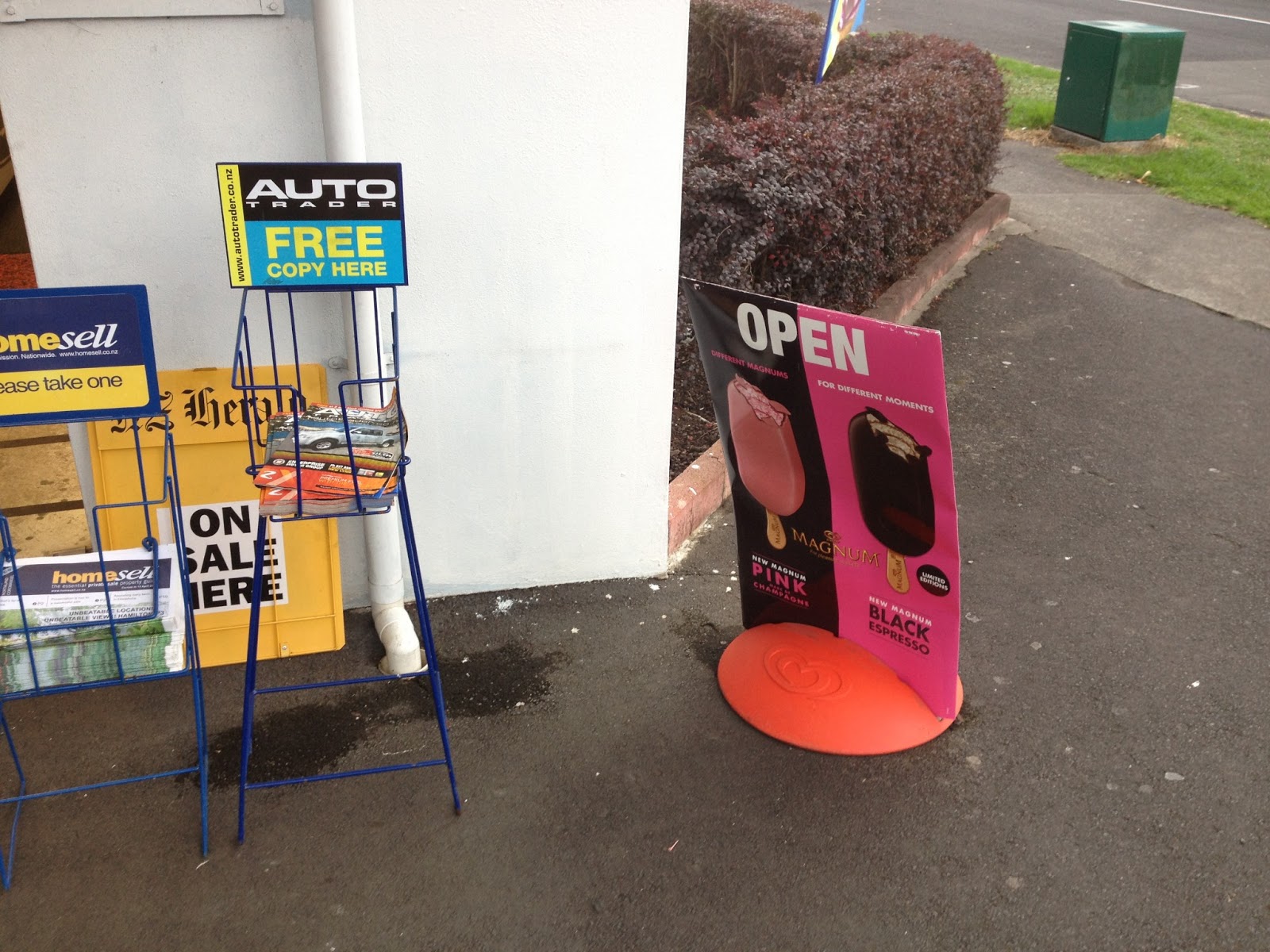
        As soon as we started seeing the advertising for these new products a month or so ago, on giant billboards as well as in dairies and bus stops, we just had to give them a go. How's "Marc de Champagne" for an exotic sounding flavour?  And wouldn't "Black Espresso" be just absolutely decadent?

        Sandwich board outside a local dairy.
        These icecreams also happened to be on special at our local supermarket, which sealed the deal.  We took home a beautiful black box (nice and flat for easy storage in our freezer) for something like $7 for four sticks.

        Magnum black: espresso flavour.
        The design was a delight to behold.  Inside the sleek box sat the individually-wrapped portions. When you open one of the foil packets, you notice that the wrapper has a gold lining, and the icecream has an "M" proudly stamped onto one side.

        Unfortunately, the flavour was rather underwhelming.  The overriding taste was that of the dark chocolate coating, which is similar to eating Whittaker's 72% dark ghana.  In order to experience the icecream inside, you needed to remove the outer layer first.  Then it is pretty much just your usual icecream with a few swirls of coffee, light in colour as well as flavour.

        Did this stop us wanting to try the pink version? Not at all. The fruit and vege shop down the road sells single servings, so we thought we would just have one each, rather than a whole box.  Turns out they were $3.50 per portion, so we might as well have bought the box for the price of our two icecream sticks.

        Single servings of Magnum Pink and Black at a local vegie store.
        These pink beauties have a slick of edible metallic paint on the outside (a "pearlescent pink coating" according to the label), which comes off on your fingers, a bit like eye shadow.  They looked amazing, but again, under that gorgeous exterior, they didn't really taste like very much.  I certainly would never have guessed "champagne" if I hadn't been told beforehand what flavour to expect.

        If Magnum's Facebook page is anything to go by, others have been less than impressed too, but clearly someone likes them, and now we can't go anywhere without noticing the signage.  The advertising pops up at the major intersections and busy areas, including:
        • Balmoral Road and Dominion Road junction
        • Sandringham Road shops
        • Newton motorway onramp
        • Ellerslie-Panmure highway
        • Newmarket, corner of Khyber Pass and Broadway
        • Newmarket, Khyber Pass motorway on-ramp
        • Fanshawe Street, on the way from the central city to Victoria Park
        We have probably seen the billboards in other places too, not to mention the signage at practically every dairy.  That marketing budget must have been huge!

        Bus stop outside our local supermarket.
        I have to admit I have a fascination with the Heartbrand in general. Owned by Unilever, it is known as Streets here in New Zealand and Australia, but has many names around the world, from Lusso in Switzerland to Good Humor in North America and China.  With such a global brand, I should probably have been less surprised that the pink and black icecreams are not made in New Zealand, but in Germany and Hungary respectively!

        Heartbrand signage from my travels: (from left to right, top to bottom) Argentina, France, UK, and Turkey.
        These new products are not bad, just not much more exciting than the other Magnum flavours. I am amazed by how much advertising Unilever is putting into them, but then again, we ended up purchasing something we would normally not have, and I am writing a blog post about it! Marketing works, and the company knows it.

        Sunday, March 10, 2013

        Fruit Salad with Mayo @ Pasifika 2013

        I absolutely shocked and quite possibly horrified a workmate the other day, when I told him that my family used to have fruit salad with mayonnaise.  "Are you sure it wasn't yoghurt?" he asked, incredulous.

        This is actually a chicken fruit salad, though it looks like the fruit salads of my youth.
        In case you didn't realise, the Chinese (my family included) don't have much in the way of salads.  We like our vegetables heated, even tomatoes and lettuce (though not generally together—the tomatoes are often eaten with steamed or scrambled eggs, and the lettuce wilted in soup or meat dishes).  The northern Chinese have cold appetisers, but even then they are made of cooked potatoes or boiled peanuts or something.

        I have always thought it a bit odd that we had fruit salad with mayo at family feasts.  Quite apart from the fact that having a salad at all was novel, mayonnaise seemed like such a Western ingredient, yet my Kiwi friends used it only for savoury mixes: potato salad, egg salad, coleslaw, maybe pasta salad.  Apart from the fruit, we also occasionally tossed in cooked potato cubes or hard-boiled egg chunks, making it somewhat closer to what the majority of New Zealanders would be used to.

        Anyway, it turns out the Chinese are not alone in adding mayonnaise to salads involving fruit.  The Russians do it.  The Koreans have something similar, throwing in crab sticks and egg with the fruit.  And despite some Americans having negative reactions to fruit salad with mayonnaise, others seem to like it or even consider it unusual for fruit salad not to have mayo!

        Today, we went to eat at the Pasifika Festival, an annual celebration of the cultures of the Pacific Islands. We strode past the "village" of Samoa, which was the first we came across and had extremely long queues. Instead, we fed ourselves from a stand in the Tuvalu cluster, where the men were busy grilling meat over a barbeque.  The women served us and scooped a salad swimming in a milky liquid onto the side of our plate—you guessed it, mayo dressing.

        Barbequed lamb and chicken with a fruit and vegetable salad in thin mayo dressing ($10).
        You only see some remnants of the salad in the picture above, but it was made with a mix of fruit and vegetables, including:
        • orange
        • apple
        • pear
        • avocado
        • cucumber
        • carrot
        • cauliflower
        and probably some other things we don't remember.  And you know what, it really worked!  It was an important component in a delicious meal, which was probably the healthiest plate you could have ordered at the event, since nearly everything else seemed to involve coconut cream, fried bread or dessert of some form.

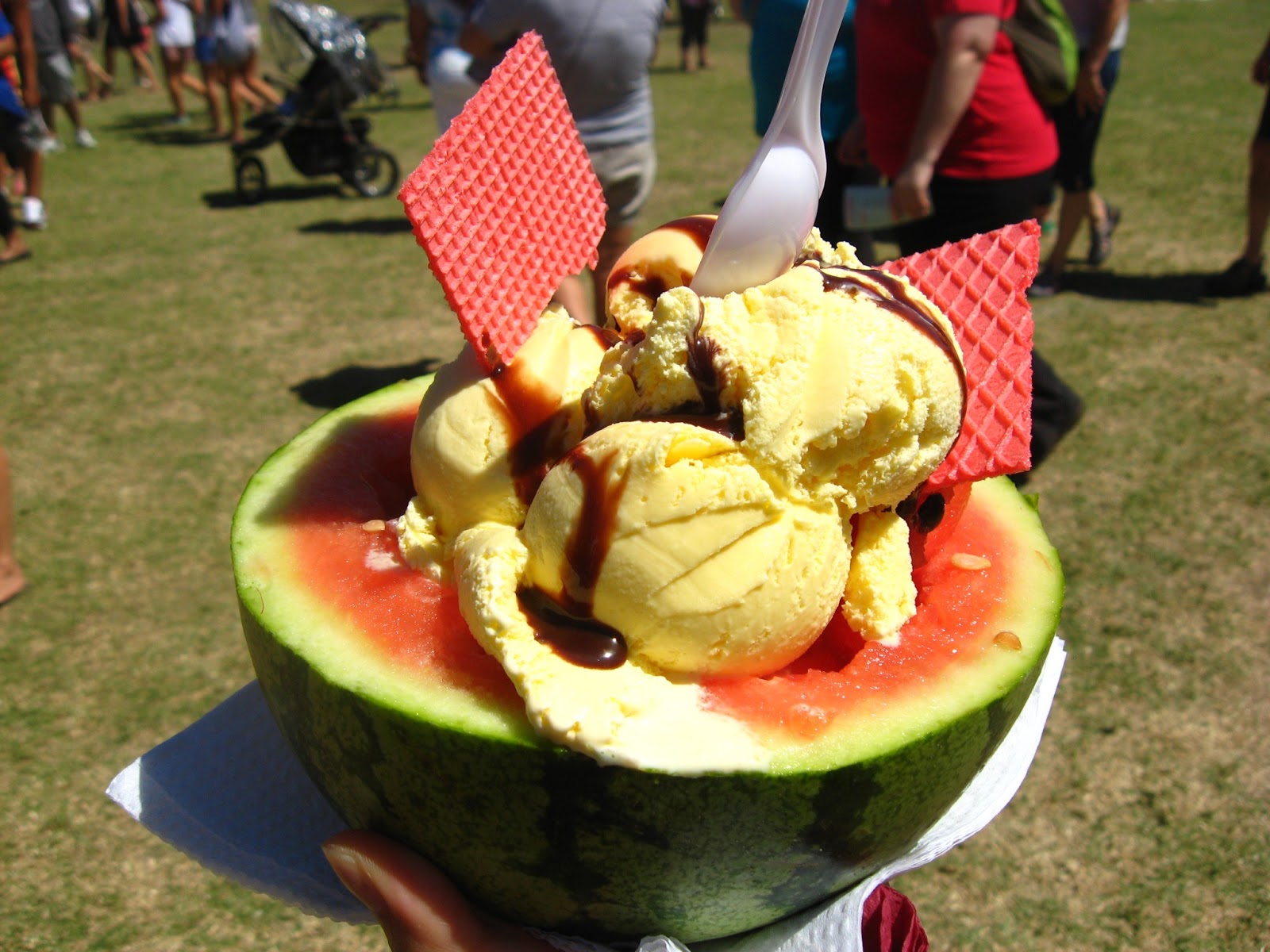
        Watermelon with ice cream ($10).

        Fried bread, with margarine and some kind of sauce ($2).
        It's far too easy to eat way too much at festivals like this, but hey, it's only about once a year, and you can blame it on cross-cultural culinary research.  In this case, I discovered more ways people make fruit salads with mayonnaise.
        Related Posts Plugin for WordPress, Blogger...