Showing posts with label Highlighted Dishes. Show all posts

Monday, March 19, 2012

D. H. Supermarket (大華超市), Mount Eden (or Eggy Experiences)

I've already waxed lyrical about the Avondale Sunday Market, but on other days, or if I don't want to venture so far for fresh and inexpensive vegetables, I head to the D. H. Supermarket (also called Dahua), a Chinese supermarket which was formerly Silver Bell.  The specials they have at the moment, for instance, are two (that's 2) small watermelons for 99c (!!! - we tried them and they were juicy and sweet too), and gala apples for 49c a kilogram!  The place is not as big and clean as the Tai Ping quite a bit up the road in Mount Roskill, but you can pick up some good bargains and they even accept credit cards for payments over something like $20.

Shelf of Asian vegetables, close to closing time.
Like other Chinese supermarkets, they have a separate meat and fish section, and you can buy groceries from other Asian cuisines like Korean and Japanese as well.  There is also a separate room for the grains and another for the alcohol (this is where you look for the Chinese cooking wine).  By the back entrance leading to the small carpark, there are mini shops within the supermarket, selling things like roast meat and Chinese street food, where you pay separately from the main supermarket cashier.

A nameless shop within the supermarket, selling such items as fried bread sticks (yóu tiáo, 油條) and sweet and savoury stuffed glutinous rice packets wrapped in bamboo leaves (zòng ​zi, 粽子).

Make sure you check what you are buying, because something which is being discounted may be expired or about to expire, and turn up early to avoid the crowds, get the best pick of produce, and perhaps breakfast on a Chinese crepe.

Highlight: Jianbing or Chinese Crepe (jiān​ bing guǒ​ zi, 煎餅果子)

[Added 4 August 2013: Sadly, this stall disappeared some time ago now.]

You go to D. H. Supermarket for your fresh vegies, mainly, but I also like the jianbing I had from one of the nameless shops there the other day.  I first ate one of these Chinese crepes at the Taiwan Cultural and Traditional Games Festival (see my previous post for a video of this being made) and have been on the lookout for it ever since.  Basically a very thin pancake with an egg cracked into it, in this case wrapping two squares of crunchy wonton wrapper, brushed with hoisin and chilli sauce, and garnished with spring onions and black sesame seeds, it is the perfect mix of sweet and savoury, softness and crunch.

A half-eaten jianbing.
Eat it immediately, while it is hot and the cracker still crisp.  Well, maybe exit the supermarket first, but don't dilly-dally.  It is such a delicious and filling meal for only $4.50 ($5 if you get it with soymilk as a combo).  The sign for the jianbing shows a photo of a multitude of grains that presumably went into the batter, so I guess you can claim it is healthy as well.

My only reservation was to do with hygiene, but I have the same concerns when I go to an icecream store and see the scoops sitting in a container of murky water.  Let me assure you that there were no unfortunate consequences to my breakfast (other than an overly full belly), and in any case, the thing is cooked for a good few minutes.

To order, point to the menu item labelled "Pan-fried roll", or look for a photo which includes an egg in it, at the stall pictured above.  A1 is currently the variety with a fried bread stick inside, while A2 is the option with the crispy wonton wrapper.  You will also be asked whether you want it spicy.  You do, because that chilli sauce is lovely.

I have seen jianbing for sale at the Pakuranga Night Market as well, but this place at D. H. Supermarket is closer and available daily.  I am tempted to say it is also more delicious, but I would have to go to the night market to verify.  In any case, I really enjoyed my crepe here.  Give it a go, even if it is weird ordering hot food from a supermarket stall.

Highlight: Eggs, Wondrous Eggs

Another great thing about D. H. Supermarket is the variety of eggs they sell.  I have seen fresh goose, duck and quail eggs here, in addition to the usual chicken variety, including free range chicken eggs.  The more exotic eggs aren't cheap, but I do an internal happy dance every time I find something novel for sale.

Fresh goose eggs for sale, when in season.
Being a Chinese supermarket, preserved or century eggs are also available.  There are two types for sale, one with what looks like a coating of clay and rice husk, and another with a smooth, blue-greyish shell.  I am not sure yet if are any flavour differences, but I will find out and let you know.

Quail eggs and two sorts of preserved eggs.
Unfortunately, they didn't appear to have any salted eggs on my last visit, which led me to purchase some  "fresh" duck eggs instead...

Lowlight: Exploding Rotten Duck Egg

What you want to do is to buy the things that everyone else buys, which are replaced regularly.  Those Asian greens are fantastic.  Avoid the things which look like they have been sitting there for a while, like the duck eggs in the fridge, which I have seen the last few times I went to the shop, but finally decided to try anyway.  I thought they were dodgy looking, the last four in the same tray for the past few weeks or longer, but there were no salted eggs for sale, and I had the idea that I would make my own.

The fact that the cashier had to leave the counter to check the price of them should have been ample warning, but I bought my duck eggs anyway.  They felt well chilled; what could be wrong?  I discovered the answer when I sat down in the car.  Just as we were about to drive home, there was a sound like a gunshot.  Something wet hit my face and the horrible sulphurous smell of rotten egg spread through the car.

The case of the exploding egg.
So there you have it.  There's good and there's bad, not to mention plenty of eggs-citement to be had at your local D. H. Supermarket.

Store Details

D. H. Supermarket (大華超市)
83 Dominion Road, Mount Eden, Auckland
(09) 630 2900

Opening hours:
Mondays to Sundays 9am - 7pm (inner shops close 6:30pm)

D. H. Supermarket is at the city end of Dominion Road.

View Nom Nom Panda in a larger map

Thursday, February 23, 2012

A week of surprises

It's been an exciting week for me, being able to try a number of different items I've never had before.  Who knew Auckland had so much to offer?

Mountain Caviar and Piko Piko @ Cocoro Degustation Dinner

I'd heard plenty of good things about the degustation dinner at Cocoro, so when Valentine's Day rolled around, it was the perfect opportunity to give it a go.  I usually find that such dinners present far too much food for one person to eat, and this was no exception.  The problem is, the dishes taste so good you don't want to let them go to waste.

The seafood, such as the blue fin tuna (sustainably farmed in Japan), was exceptional, but I was particularly happy to be able to taste some ingredients I have never seen before.  On top of the beautifully light and crispy courgette filo tempura, which looked like a bird's nest, there was some "mountain caviar".  The waitress assured us this was vegetarian, and the menu called it "belvedere fruit".  I didn't even know such a thing existed.  It didn't taste like much, but I guess it's used as a garnish (the Japanese call it tonburi and it's apparently a delicacy of the Akita prefecture) because of its caviar-like texture.

One third of the third course: Courgette filo tempura, Worcestersire sauce, egg tartare, belvedere fruit or "mountain caviar".
While Cocoro is a Japanese restaurant, the chef also uses plenty of New Zealand ingredients, from the karengo seaweed sprinkles to the whitebait in the chawanmushi.  For the first time ever, I was also able to try eating a piko piko frond.  This Maori fern shoot tasted like a bitter green bean or asparagus.

From the vegetarian degustation menu: Summer vegetable tempura of courgette flower, piko piko, eggplant and baby carrot with micro mizuna, karengo and cauliflower in white vinegar dressing.
6-course degustation dinner ($80) at
Cocoro
56a Brown Street, Ponsonby
(09) 360 0927
Sundays and Mondays closed.
Tuesdays to Saturdays 12 - 2pm and 5:30 - 10pm

Exotic Fruit @ Bhana Brothers

While wandering around the streets of Ponsonby, I found myself in what looked like a well presented dairy, with fresh flowers outside and spacious aisles inside.  It had no sign on the door, so it wasn't until I bought something that I discovered this was Bhana Brothers, a family business that has existed for over 70 years now.

Apart from the handmade tortas de aceite (Sevillian olive oil wafers) which Anna from Eats By Anna had raved about, and other upmarket products like Clevedon buffalo cheese, this shop has fruit I haven't seen for sale before, not even at my local Nosh Food Market.  I call them exotic for this reason, though plenty of New Zealand families have figs and cape gooseberries (I first knew of them as "physalis") growing in their (grandma's) backyards.  Presumably figs aren't often sold because they don't transport or keep well, and I had never come across the very sweet and green little spheres called greengages before.

Greengages, fresh fig and cape gooseberries from Bhana Brothers.
Other fruits on the shelf which I was impressed to see, but less excited by, included pomelos, kiwiberries and horned melons (or kiwanos), as well as fresh blueberries, raspberries and blackberries.  Not your average dairy, that's for sure!

[Added 3 March 2012: Found cape gooseberries and greengages slightly cheaper at a grocer called Kumeu Produce Market (407 State Highway 16, Kuneu) as well today.]

Bhana Brothers
129 Ponsonby Road, Ponsonby
(09) 376 5329
Mondays to Sundays 8am - 7p

Nettle Goats Cheese @ Crescent Dairy Goats

Someone told me about a little farm not far from central Auckland, where they make their own goats cheese, so I naturally had to check it out.  To get to Crescent Dairy Goats, you basically drive to the end of the Northwestern motorway and turn left before you get to Taupaki (turn off before Kumeu).  From there, it's pretty well signposted.

The softest cheese they had at this time of the year, which they called "Flat White", was delicious, creamy and mild.  They have a whole range of goats cheeses, including blue cheese, and I chose to try their "Farmhouse Sting" next, so named because the cheese is marbled with nettle leaves, which is apparently safe to eat in the cheese, though you shouldn't go around munching on fresh nettle.

Two of many varieties of goats cheese for sale at Crescent Dairy Goats.
They offer a tour of the farm for $15 (minimum of 10 people required), where you get to meet the goats, have a tour of the milking and cheese making areas, then sit down for a taste of at least ten of their cheeses with tasting notes and commentary from the cheesemaker.  I haven't got around to it yet, but I am definitely planning to round some people up for this!

Crescent Dairy Goats
177A Taupaki Road, Kumeu
(09) 412 2074
Mondays closed.
Tuesdays to Sundays 10am - 5pm

Molecular Gastronomy @ FISH

If you thought FISH was just a simple seafood restaurant, any such illusions are immediately dispelled when the waiter brings out ciabatta rolls with what looks like a pale green mousse on the side. This turns out to be a very soft and light spread made from olive oil emulsified overnight using the enzymes from some kind of tree sap.

From this beginning, the mouthful of brocolli soup served in a flat glass tube, or the oysters with balsamic and chilli sauce in eye droppers, or even the fish and chips with what looks like rice bubbles in the batter, should no longer be a surprise.

They really turned up the heat though, or cold, rather, when I ordered the nitro toffee & coffee mousse, which became a full scale performance.  A side table was set up so that we could see the swirling mist from the liquid nitrogen cooling a ball of mousse, injected with the filling before our eyes.  The outside of the ball solidified, while the inside was still gooey.

Preparing the nitro toffee & coffee mousse.
Mousse ball ripped apart.
Yes, it's gimmicky, but the flavours are right up there, and it's nice to try something like this at least once.

In related news, the first issue of the International Journal of Gastronomy and Food Science is out (you can download the electronic versions of the articles for free), and celebrity chef Heston Blumenthal has been asked to cook the first synthetic meat burger later this year.

FISH
Hilton Auckland, Princes Wharf, 147 Quay Street, Auckland Central
(09) 978 2020
Mondays to Saturdays 12 - 11pm
Sundays 12 - 10pm

Saturday, September 17, 2011

Fashionable Fried Foods

I eat far too many chips, glorious hot chips.  Also known as fries, they are one of those delights I can't (or refuse to) make at home. I don't want to indulge myself too often, and well, deep frying just gets messy, quite frankly.  I mean, what are you supposed to do with all that spent oil? Much better to leave it as someone else's problem, I say.

You can get a whole raft of other fried delicacies at restaurants these days too. The deep-fried icecream balls I enjoyed at as a child in the older (Westernised) Chinese restaurants don't seem to be around much anymore, but I keep getting excited about something new, only to find that it's suddenly available in multiple places.  Is this simply because I start paying more attention to the existence of this novelty, or do fried foods come in fads?

It's still possible to order deep fried ice cream at Sam Woo Vietnamese Cafe in Otahuhu, among other places
Jazzed up Potato Chips

Ever since Burgerfuel brought chips with aioli into the mainstream, it doesn't seem quite right anymore to eat them simply on their own.  Other places make their chips more interesting by covering them in beer batter or seasoning, but I'm fnding that you can buy them in all shapes and sizes too.

If you argue over whether thick or thin chips are better, what about the ones which are rectangular in cross section, short on one side and longer on the other?  I've had super-chunky chips at Finc in Wellington, measuring maybe 3cm on two sides and deliciously crispy and golden; our capital also offers fried potato in cubes, as in the Wagyu Fat Potatoes with Habanero Mayonnaise available at Logan Brown.

You can choose between fatties or skinnies chips (as well as wedges) at Velvet Burger
Then there are the chips you would need special implements to cut, like curly fries and crisscut fries. I've only seen these sold in seasoned and battered form.

Curly fries at Vinyl Coffee Shop
Crisscut fries at Carl's Jr. in Takanini
Of course, wedges are made of deep-fried potato too.  For some reason, we never call them "chips", maybe because most places will serve both at the same time.

Wedges served with bacon, cheese and sour cream

I won't go into the various ways you can serve chips, though I have to say that I was surprised to see a "French Fries Sandwich" on offer at Holy Land, a new restaurant (347 Karangahape Road) for Arabic and Western cuisine. From the picture on the menu, it looked like a pita pocket filled with chips.

Exotic Chips

Remember when kumara chips were exciting and new? They never seem to attain the same level of crunchiness that chips made from potato do, but I am often tempted to order them just for variety.  I've already shared my non-potato chip discoveries in previous posts, involving pumpkin chips coated in salty egg yolk at Fung, and polenta chips at Coco's Cantina (I also saw some polenta chips for sale at La Zeppa and 1885, but never got around to trying them and they don't seem to be on the menu anymore).

Pumpkin chips coated in salty egg yolk from Fung

Today, I came across a little mobile vendor selling "South American Street Food" on Queen's Wharf.  Top of the list on Maldito Mendez Cantina Latina's menu was "mandioca chips with smoked garlic aioli", which on further questioning are made from cassava.  They tasted good, but were relatively dry and hard compared to potato chips.  I'm keen to try the cassava chips at Bellota too.

Cassava (a.k.a. mandioca or yuca) chips with smoked garlic aioli from Maldito Mendez

Churros

My first experience of churros in Auckland was at the Teed St Larder in Newmarket. Unlike the straight dough sticks I had dipped into hot chocolate in Spain, the ones at the Larder were twisted into a knot.  They were reheated rather than freshly made, but still managed to remain crispy and ready for dipping into chocolate sauce or dulce de leche.

Churros from the Teed St Larder
Beautifully delicate churros can be had at Serafin, and they even added a bit of alcohol to our chocolate the last couple of times we were there.

Fortunately, you can also have churros without going to a cafe or restaurant.  Toro Churro sells these delicious sticks from mobile carts, which can be found by AUT on weekdays, as well as at various places like the Auckland Night Market at Pakuranga at other times. They even have caramel-filled ones!

Churros from Toro Churro

Beignets

Recently, I came across beignets (pronounced "ben-YAY"), which basically seem to be doughnut balls.  I've seen the term applied to both sweet and savoury ones, shaped as big spheres or little pillows, but for me, the definition of beignets will always be the sweet morsels I first sampled at Sweet Mother's Kitchen.

Delicious beignets from Sweet Mother's Kitchen,Wellington
Corn beignets from Okra in Kingsland
Beignets with passionfruit curd, only available for breakfast at Depot, opposite the Auckland Sky Tower
***
Just the other day, a friend told me about deep-fried poached eggs, coated in breadcrumbs.  I'd hardly say that it is a dish sweeping through restaurants around Auckland, but it does sound worth a try.  What other new offerings have you come across, and did you suddenly start noticing it at other restaurants?

Thursday, June 30, 2011

Still Missing Malaysia

Thanks to various bloggers, I've discovered that some specialties available in Malaysia, which I thought weren't available in Auckland, can actually be found here.  Things like fresh durian, fresh roti canai and banana leaf rice,which I'll go into in a minute.  And though I have yet to see another establishment sell a kaya toast set here since the demise of Kaya+Toast (mentioned in my previous post), it is pretty easy to create it yourself at home.  What I absolutely don't have information on, though, is the dish that my friends roundly regarded as our best meal in Malaysia: beef ball noodles from a stall in the basement of the Lot 10 shopping complex.  Not only have I failed to find a place which sells this in Auckland, but I have failed to find a recipe for it on the web, though there were plenty of photos in the search results.

A half-eaten beef ball noodle set.  The noodles were pale yellow to begin with and came with vegetables which also had a dark sauce on top.

"What do you mean", I can hear you asking.  "I've seen plenty of places around selling beef balls and noodles."  Well, yes, but they aren't the same beef ball noodles.  What you are probably talking about is beef ball noodle soup.  These were dry noodles, with a combination of two dark sauces ladled over the top, the secret ingredients of which I would dearly love to know.  I am pretty sure that the lighter of the two was made of minced pork, and I found something in the Asian grocery store which resembled the contents of the darker sauce: Chinese olives preserved with vegetables (gan lan cai, olive vegetable or 橄欖菜 on the label).  But what have they done with these things to make the sauces taste the way they do?

I'd rather dwell on my successes, so let me tell you about the dishes that I have managed to find...

Fresh Durian

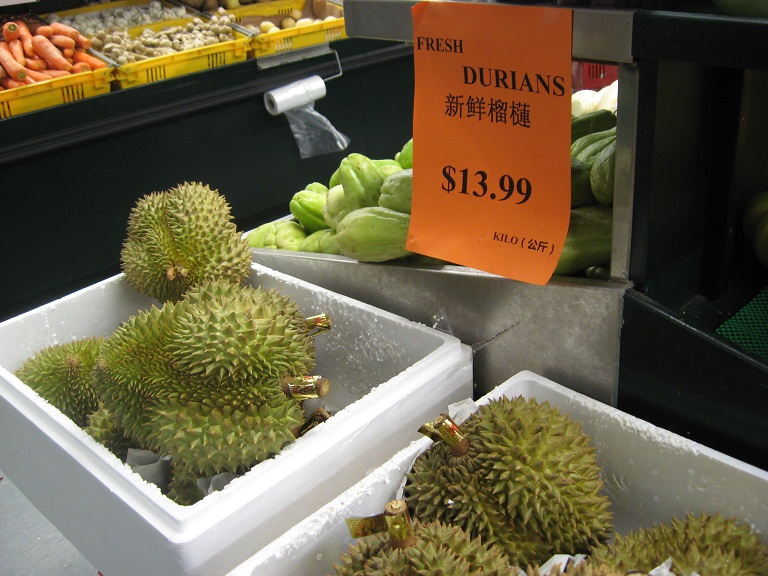
Okay, so durian is not so much a dish as an exotic fruit.  Frozen durian can help satisfy a strong craving for its fragrant flesh, but nothing beats the taste of a fresh creamy durian.  Widely known as the King of Fruits in Southeast Asia, it is probably considered more a Tyrant of Fruits by those who dislike its strong odour and unusual flavour.  You'll never know if you are a lover or a hater of this plant till you give it a try, so round up your friends for a culinary feast (to share the fun, and because you will never get through a whole durian by yourself).

Knowing durian is in season and acting on a tip, I could already smell my target before I entered the fruit shop housing it.  After picking out a 2.5kg specimen (shipped over from Thailand) and getting it wrapped in newspaper, I placed it in the boot of my car for transportation.  I should have thought to bring plastic ziploc bags with me, because I could smell it in my car for a week after I brought it out for slaughter.  Having the beautiful, spiky ball in my hands was worth it though.

Fresh durians for sale in Newmarket
My durian, cut open
And the verdict?  This durian tasted just like the durians we ate in the streets of Kuala Lumpur, but there were some crunchy bits along with the soft, gooey goodness.  I am guessing I should have given it an extra few days to ripen before consumption.

Available for $13.99/kg at
Song Kee Fruit & Veges
5-11 Kent Street, Newmarket, Auckland (that one way bit under the Rialto carpark, opposite the Newmarket Plaza food court)
(09) 520 6288

Fresh Roti Canai

I've been told there are a couple of places in Auckland where you can buy fresh roti canai, spun out on order in front of your eyes.  I've only been to Tastes of Malaysia in Manukau, and I don't need to go anywhere else, because the roti canai here are exactly how I expect them to be, soft and layered, with some crusting on the outside.

Roti canai with Chicken Curry, served on a plastic banana leaf plate with a small salad garnish on the side
The only disappointing thing is that they were rather slow to arrrive.  Friends who ordered the mamak mee goreng got their meals first.  A very hungry friend looked on jealously and quickly ordered a mee goreng of his own, which still arrived before the roti he had previously ordered.

I should also point out that this place is in a food court, but since when has ambience been an issue in the pursuit of good food?

Roti canai being spun out
Available for $4 - $12 at
Tastes of Malaysia
"Food Junction" foodcourt, 615 Great South Road, Manukau, Auckland
 (09) 262 2066

Banana Leaf Rice

The first time I was introduced to banana leaf rice in the outskirts of Kuala Lumpur, I was blown away.  Eating off a banana leaf was quite a novelty on its own, but having a whole range of vegetarian side dishes to accompany your dhal/gravy on rice was even better, especially when I discovered that all those exciting options (deep-fried bitter melon slices were my favourite) could be topped up endlessly, all for the equivalent of about NZD$2.

On my more recent trip to KL, we only managed to find a banana leaf rice place in the upmarket suburb of Bangsar.  The food was equally delicious, with seemingly more meat and fish options, but you had to pay extra for top-ups of side dishes, which included deep-fried okra, leafy greens and cucumber chunks in yoghurt.  Some friends had the optional chicken rice and extra meat dishes, and we all had a refreshing lime drink, making for a most satisfying meal.

When I discovered a restaurant in Auckland offering banana leaf rice, I just had to give it a go.  The first thing that was different compared to my Malaysian experiences was that containers of food were placed in the middle for you to serve yourself, rather than having someone come around and dish up each option.  In both cases you have control over how much goes onto your banana leaf plate, but I guess in the NZ version, you could end up with wasted food at the centre of the table, and presumably the labour costs in Malaysia are much lower.

Another difference was that you could eat as much as you wanted.  Not just the rice and side dishes, but also the chicken and lamb curry mains (sorry vegos, you have to make do with the sides, unless you want to pay extra).  I've always felt somewhat shortchanged at all-you-can-eat places, mostly because I don't eat that much, and I can think of other places where you could have done better for less.  Well, I don't know of any other banana leaf rice restaurants in Auckland, but it felt a little bit more expensive than I expected anyway.

Although the food tasted good at Santhiya's, the most interesting bits were missing from their banana leaf Sunday Special.  You got a poppadom, but no pickles or salted chilli.  You got side dishes, but they were braised cabbage, grated carrot in a sweet vinaigrette, lentil and potato dhal, and a kind of chutney; I missed the deep-fried curiosities, the dark leafy vegetables, the unusual flavours of unidentified ingredients.

Side dishes for banana leaf rice at Santhiya's
Not the best picture of banana leaf rice
Whatever its shortcomings, though, I am glad to have found a banana leaf restaurant in Auckland.  It brings back pleasant memories, and it is always great to have more diversity in the food scene.

Available for $16 (lunch) or $19 (dinner) on Sundays only at
Santhiya's
1270 Dominion Road, Mount Roskill, Auckland
(09) 620 2986
Mondays closed.
Tuesdays to Sundays 11:30am - 3pm and 5 - 9pm

Tuesday, March 29, 2011

Prickly Palusami @ Pasifika 2011

I have had very little to do with Polynesian cuisine so far, so I was excited to discover a couple of weeks ago that the Pasifika Festival was on.  With lots of stalls and performance areas clumped in "villages" around the beautiful Western Springs park, there was plenty of opportunity to try new foods and generally have a great day.

One of the "villages" by the lakeside

For me, practically everything was a novelty—from the 'ota 'ika (raw fish salad in coconut cream), pork buns and pani popo (buns in coconut milk sauce) which my friends went for—to the curry on cassava, pisua (a tapioca dessert which tasted of butterscotch) and pani keke ("banana pancake", more like deep-fried spherical donuts to me) which I tried—to the curiously-named items that we giggled at but did not manage to sample, like poke (Hawaiian raw fish salad) and 'otai (fruit drink with coconut milk).  Sapasui (chop suey mainly made with Chinese vermicelli, a.k.a. bean thread or glass noodles) and watermelon icecream also seemed to be very popular.

Watermelon icecream
What was for me the most memorable dish though, was the palusami (coconut cream and onions wrapped in taro leaves).  I was particularly curious about this as I had just read Jeffrey Steingarten's terrible reaction to eating food served on a raw taro leaf garnish in his book It Must Have Been Something I Ate.  I had also tried patra or alu vadi (taro leaf rolls) at one of my favourite Indian restaurants, Ras Vatika, which I enjoyed.  I simply needed to try taro leaves in another delicacy.

My first reaction was that it was delicious.  With coconut cream and savoury onions, the spinach-like packet was very tasty indeed.  As I ate though, I began to feel a prickling sensation in my mouth.  By the time I got to halfway through the palusami, it was actually painful.  Fortunately, unlike Steingarten, my breathing was not affected; but suffice it to say, I had difficulty convincing anyone else to try palusami from another stall.

Half-eaten palusami
Is this feeling normal from a prepared dish?  Is it bad for you?  Everything I have read suggested it was perfectly safe to eat cooked taro leaves, and my palusami certainly looked thoroughly cooked.  The acridity in raw taro is caused by raphides, or needle-like crystals, of calcium oxalate, which are located near stores of protein-eating enzymes, creating what Harold McGee calls "poison-tipped darts" in his book On Food and Cooking: The Science and Lore of the Kitchen.  According to him, cooking breaks down the plant's defence system by "denaturing the enzymes and dissolving the crystals."  Could it be that my palusami simply wasn't cooked enough, even though it looked limp?

I haven't completely worked it out yet, but from what I gather from the Taro Wikispaces page, it's not so much the insoluble oxalates such as calcium oxalate which you should be worried about.  These pass through your system, while the soluble oxalates (which also exist in taro leaves) are easily absorbed and can lead to kidney stones.  You want to boil your leaves (or apply some other moist heat treatment) and throw away the water to reduce the soluble oxalate levels.  You can also eat your taro leaves with a calcium-rich food like milk so that insoluble calcium oxalate salts get formed, thus reducing oxalate absorption.

After reading the sections on Elephant Ear (a close relative of taro, with large leaves) and Taro in the book Poisonous Plants of Paradise: First Aid and Medical Treatment of Injuries from Hawaii's Plants by Susan Scott and Craig Thomas, it occurs to me that I may have eaten a specimen of the plant that simply cannot be made edible by any amount of cooking.  Perhaps cooks would do well to heed the advice shared on Elaichi et Cetera: "A tip from Vee of Past, Present and Me: break the stem of an arbi [a.k.a. taro] leaf you intend to use, rub the juice on your inner wrist and count to ten; if it stings, the oxylate concentration is too high. Don’t use them."

Thursday, February 24, 2011

Serendipity

Every time you go out to eat, you are in search of a wonderful meal.  But sometimes, just sometimes, you come across something that you have not seen anywhere else before, something different and exciting.  Below are some foods that I have been surprised by, mainly pleasantly.

Polenta Chips

I love eating hot potato chips, so when I saw polenta chips on the menu at Coco's Cantina, I had to order some for comparison, even if it meant downgrading to an entrée for dinner.  I was not disappointed.  The long chunky chips were fragranced with rosemary, and stayed crisp and hot for much longer than you would expect.  They were absolutely delicious with or without the accompanying aioli. Just be careful you don't burn your tongue!

Polenta chips with aioli
Available for $8.50 at
Coco's Cantina
376 Karangahape Road, Newton, Auckland
(09) 300 7582
Turesdays to Saturdays 5pm - late

Feijoa Cider

Just up the road at the Wine Cellar, a basement bar in St. Kevins Arcade on K'Rd, I tasted feijoa cider for the first time when a friend played a gig there nearly a year ago.  Not only was it a proper cider rather than feijoa mixed with wine, it also came on tap.  It was fruity and intoxicating, and absolutely the best cider I have ever had.  Made from organic feijoas from Purangi, it tasted different every time I returned.  It was not always available, and it was never as good as I remembered again (sometimes it had a bitter aftertaste, more like beer) but I still go back once in a while to see if I can taste the most fantastic cider again.

Available (call first to make sure) for $7 a glass or $9 a pint at
Wine Cellar
St. Kevins Arcade, 183 Karangahape Road, Newton, Auckland
(09) 377 8293

Chirimoya Juice

I had never even heard of chirimoya before seeing its juice offered at Mexican Specialties.  This South American fruit (I bought a whole one to admire, and the chef picked out a ripe one for me that was ready to be eaten that very day) is related to the custard-apple, and looked green and scaly.  The juice was sweet, with a tropical flavour.  It wasn't available last time I visited the restaurant, so I am guessing it is out of season (I had it a couple of years ago, around October), but with other items on the drink menu such as cold chocolate, tamarind juice, pineapple and coconut, and lemon and lime, I wasn't about to complain.

Mexican Specialties
92 Marua Road, Ellerslie, Auckland
(09) 580 2497
Thursdays and Fridays 11am - 3pm
Saturdays 10am - 4pm

Sweet Masala Pan

Having studied Latin throughout high school, I could only associate the word pan with bread.  In India, this word means nothing of the sort.  Pan, or paan, refers to the betel leaf, which is commonly used to wrap a an assortment of fillings.  The sweet variety does not contain tobacco, and the lady at Ras Vatika assured me that this would be refreshing and good for the digestion.  As I was feeling full from dinner and wanted to find out more about this novelty (I hesistate to call it a dessert, even though it is sweet and eaten after dinner), I took one of these little green packets home.

As I was completely clueless about sweet masala pan, I decided to do some web research.  Were you supposed to eat the packet whole, leaf and all?  Were you supposed to chew and spit, or actually swallow the thing?  What is this betel business anyway?  What I discovered put me off altogether.  Apparently, the areca nut, commonly known as betel nut, which was listed as one of the fillings of my pan, can cause oral cancer.  Now, I know that there are a gazillion things in the world which can give you cancer, including burnt toast, but that doesn't mean I want to take my chances.

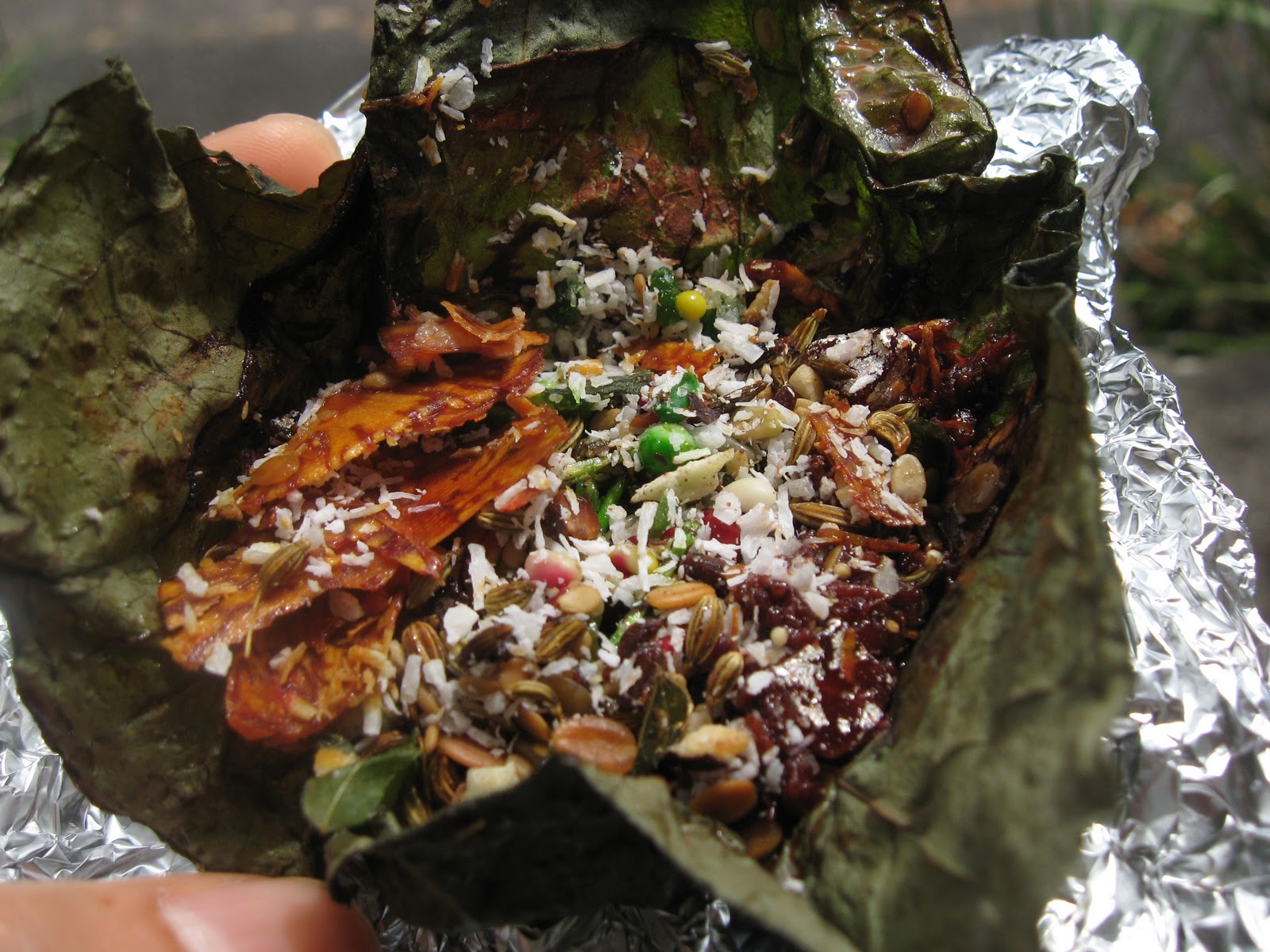
By the time I plucked up the courage to try some meetha pan, I had left the thing in the fridge so long that the leaf was shrivelled up and more unappetising than ever.  Cautiously, I opened up the leaf wrapper, to investigate the contents.  It smelt of mint and rose, and I saw dessicated coconut, fennel seeds, unidentified coloured candies, a reddish brownish sauce and some bark-like sheets that I assumed was the areca nut.  I admit that I only had the tiniest ever little pinch of the filling, but it tasted as it smelt, of menthol and flowers.  I may give it a proper go some day, but I suspect this is one of those things that may be an acquired taste.


Sweet masala pan, with the betel leaf opened up
Ras Vatika
596 Dominion Road, Balmoral, Auckland
(09) 623 2145
Mondays closed.
Tuesdays to Sundays 11:30am - 10pm
Related Posts Plugin for WordPress, Blogger...