Showing posts with label Exotic Fruits. Show all posts

Monday, April 6, 2015

Incredible Edibles and More @ Kings Plant Barn

We went to Kings Plant Barn in Saint Lukes last weekend, and I was amazed by the diversity of edible plants you could buy from there. I expected maybe herbs and different varieties of things you can find at the supermarket, like lemons, tomatoes, feijoas and even figs and passionfruit, but there were plenty of other exciting plants too, including ones I would never have thought of growing (like peanuts or pine nuts) and ones that I had not heard of till now (like orangeberries).

The Incredible Edibles Range

Many garden stores (as well as hardware stores like Bunnings which have garden sections) now sell the Incredible Edibles range of fruiting plants, and there are so many delicious-sounding things I would love to try!

Here are some that I have seen for sale:
  • Chilean guava (a.k.a. NZ cranberry)
  • Coffee
  • Guava
  • Japanese raisin
  • Mountain pawpaw
  • Mulberry
  • Orangeberry
  • Pepino

Orangeberry plants next to a sign with precautions because of the Queensland fruit fly.

Unusual Citrus Fruit

Apart from the lemons and limes, there were some interesting citrus varieties for sale. I was particularly intrigued by the finger limes and limequats.

Finger lime plants.

Limequat espallier.

Asian Herbs and Vegetables

Asian ingredients are widely available these days, but if you want to grow your own, you can do that too! Growing herbs (Asian or otherwise) is always a good idea because you only need a little bit, and they are so expensive if you buy them when you need them.

Here are some Asian herbs and vegetables I came across at the garden centre:
  • Lemongrass
  • Vietnamese mint
  • Curry tree
  • Snake bean
  • Edible chrysanthemum ("tong ho" in Chinese)
  • Peanut
Edible crysanthemum.

"Superfoods" and Medicinal Plants

If you are after plants with supposed health benefits, you are also in the right place. For example, you could grow your own:


Chia seedlings, amongst other plants.

Gotu kola and goji berry plants.

I don't have a big enough garden, or enough time and experience to grow these things, but it's good to know the option is there!

Friday, November 21, 2014

Foodie Excursion: Wintergardens, Auckland Domain

One of my favourite spots around town is the Wintergarden complex in the Auckland Domain. The greenhouses look amazing, both inside and out, and they are full of beautiful plants that you don't often get to see.

Colourful flowers at the Wintergarden.

When we visited last weekend though, I was surprised to notice some food-related plants that I didn't remember seeing before.

Torch ginger, also known as ginger flower or bunga kantan, is used in South East Asian dishes such as Penang asam laksa, as well as eaten in a fruit salad in Thailand.

Torch ginger.

Sago palm is used to produce the translucent pearls which make me think of puddings and soupy desserts, but the starch is apparently also used to make noodles and white bread in some places.

Sago palm.

Coconut palm is the plant that gives us coconuts. You may remember my experience making my own coconut milk last year.

Coconut palm.

Coffee lovers might be interested to see Coffea arabica, though it looked mostly like a jumble of leaves.

Arabian coffee.
Then there were things that reminded me of food, like the water lilies that made me think of lotus flowers.

Lilies in a pond, and more.

These crazy-looking fruit are buddha's hand citron, or fingered citron, which are basically ornamental citrus fruit.

Buddha's hand citron.

We also saw a bird's nest with an immobile bird in it, which we initially was a fake animal, and, of course, plenty of flowers of different shapes and sizes.

There is construction going on around the Wintergardens right now, but the place is still open to the public and so worth a visit!

Outside of the Wintergarden.

Friday, February 28, 2014

Homemade Loquat Liqueur

A relative has a loquat tree on their property. Several months ago, it bore fruit, and we were gifted with a large number of the sweet, aromatic spheres.

Loquats on the tree.
It was the first time we had ever tried loquats, and I thought they were cute, held together by chubby, furry stems.

Ripe loquats.
There wasn't much flesh in each fruit, as a lot of the space was taken up by the seeds in the centre, but what there was was delicious at the right level of ripeness.

Inside a loquat.
As we had more than we could eat, I tried to make dried fruit out of most of them, putting the cut halves into the barely warmed oven over a number of days.

Loquat halves laid out for drying.

Sadly, that was a waste both of effort and delicious fruit, as even days later, the pieces were still not dry (perhaps I should have turned the oven on for longer). Pricking the skins with a fork and turning some of the pieces over did not help much either. Not only that, the orange rounds had oxidised and turned black, and the beautiful fragrance of the fresh fruit was no longer there.

Unattractive partially-dried loquats.
I put the shrivelled-up, leathery and not very sweet loquat pieces into a jar, thinking I could bake them into something perhaps, but by the time I remembered them, they had started to grow mouldy. Epic fail.

All those loquats left me with something else on my hands. I did not want to simply throw the seeds away, and when I discovered that people made loquat liqueur with them, I decided to give it a go as well. I haven't had success with brewing in the past, but loquat liquer didn't require any skills or special equipment. This was really only going to be a vodka infusion.

Loquat seeds.
Possible Poison?

While searching for recipes, I came across some pretty scary sounding advice out there. For instance, a post  by bpotter on the GardenWeb forum claimed the seeds contain a dangerous level of cyanide compounds:
Most of the stone fruit (peaches, apricots, plums) are in the rose family and loquats (at least 2 different species I know of) are members. Their pits contain dangerous levels of cyanide compounds. Our native holly-leaf cherry was used by the native Chumash people as a source of food and they knew that they had to leach out the poisons from the pits by repeated soakings and boilings before they made a mush out of them.
Others, such as Susan Lutz at Zester Daily, point out that while the pits contain toxic substances, there is not enough to worry about:
I put in a call to professor Jules Janick, director of the Indiana Center for New Crops and Plant Products at Purdue University. He’s not only the co-editor of “The Encyclopedia of Fruits and Nuts,” he is also a kind and understanding voice of reason. Janick told me that loquat seeds are indeed toxic, but then so are the seeds of apples and pears. To put things into perspective, Janick said, “If you ate 3 pounds of them, then it might be a problem.” He also reminded me that the bitterness of the seeds would stop someone from eating them pretty quickly. I realized that my daughter was at far greater risk for choking on a loquat seed than being poisoned by its chemical components.
Then there are those who deliberately eat the seeds out of the belief that it can help combat cancer. A modified form of the chemical amygdalin found in the pips (also in the kernels of apricots, peaches, cherries, and almonds) is marketed as Laetrile, although there is no proof that it is effective against cancer.

I wasn't able to find out how dangerous loquat seeds were, but I did come across some tables for other foods. This came with the warning that "cyanogen levels can vary widely with cultivar, climatic conditions, plant part and degree of processing."

Food Sources of Cyanogenic Glycosides and Amount of Hydrogen Cyanide (HCN) Produced
PlantCyanogen content  (mg HCN/kg) Major cyanogenic glycoside present
Giant taro (Alocasia macrorrhizos) – leaves29-32Triglochinin
Nectarine (Prunus persica var nucipersica) – kernel196-209Amygdalin
Flax (Linum usitatissimum) – seed meal360-390Linamarin, linustatin,
neolinustatin
Peach (Prunus persica) – kernel710-720Amygdalin
Plum (Prunus spp.) – kernel696-764Amygdalin
Apple (Malus spp.) – seed690-790Amygdalin
Apricot (Prunus armeniace) – kernel785-813Amygdalin
Cassava (Manihot esculenta) – root15-1000Linamarin
Sorghum (Sorghum vulgare) – leaves750-790Dhurrin
Whole Sorghum2500Dhurrin
Lima beans (Phaseolus lunatus100-3120Linamarin
Bitter almonds (Prunus dulcis)2500-4700Amygdalin
Bamboo (Bambusa arundinacea) – young shoots100-8000Taxiphyllin

The numbers above don't entirely agree with a New York Times Q&A piece, which quotes Dr. Margaret Dietert, associate professor of biology at Wells College, Aurora, N.Y., in saying that "13 to 15 raw peach pit kernels would get you into the lethal range for adults", while the level of cyanogen in apple seeds is "about a quarter as much as peach pits for the same weight".

Meanwhile, food scientist consultant John Fry has this to say in The Naked Scientists, again about apple pips:
You need about 1 milligram of cyanide per kilo of body weight to kill a human being. Apple seeds contain about 700 milligrams of cyanide per kilo, so about 100 grams of apple seeds should be enough to dispatch a 70-kg adult human, but that’s an awful lot of apple cores even if you don't eat the rest of the apple first. In addition, the seeds would have to be pretty finely crushed to let the enzymes get to the amygdalin at all. All in all, you're safe eating the occasional apple core. I've done it for years. Just don't try eating a bowl of freshly crushed apple pips.
I still had some reservations about eating anything made with loquat seeds, but seeing that people even use the roasted seeds as a coffee substitute helped to allay those fears.

Making Loquat Liqueur

Although loquats come from China, they are also common in other countries such as Italy, where they are called nespoli. A liqueur made from the loquat seeds is called nespolino, similar to nocino made from unripe green walnuts, and amaretto made from apricot kernels or almonds.

I roughly followed the directions from Gardenista, which went like this:
Rinse seeds and set out in the sun to dry for two weeks.
The classic Italian recipe calls for grain alcohol, but a neutral vodka works as well. To the pits, add one whole vanilla bean and 1/4 of a lemon rind, pith removed. Let this sit in the sun for about a month. Add a sugar simple syrup to taste, and then let it sit for another two weeks.
I'm not sure why the seeds should be set out in the sun to dry. Another recipe for loquat grappa omits this step. Perhaps it helps to intensify the flavour?

Loquat seeds with lemon peel in vodka.

After a couple of weeks of soaking, I noticed that the liquid level had dropped in my jar. Did the alcohol evaporate away somehow, or did it get absorbed into the seeds? I topped up with more vodka, and noticed a delicious almond and floral fragrance already.

Reduced level of liquid.
After a couple more weeks, the liquid level had dropped again, but this time, instead of topping up with more alcohol, I made a sugar syrup and poured that in. I promptly forgot about it for another month, even though I had meant to take the seeds out after two more weeks. I don't think that did any harm though, seeing as there are recipes that call for soaking the seeds for up to six months.

Fragrant end product.
And the end product? The almond flavour was more pronounced, and overlaid with a pungent one that you might poetically describe as "formaldehyde". According to the PICSE website, amygdalin "in the presence of water and the enzyme beta glycosidase (Emulsin) releases glucose, hydrocyanic acid (Prussic acid) and benzaldehyde... It is the Benzaldehyde is responsible for the bitter astringent taste while the Hydrogen Cyanide is responsible for the almond aroma." Interesting and complex to your senses then, but not something that I will be having large amounts of.


This post is part of Our Growing Edge, a monthly blogging event aimed at inspiring us to try new things. This month, it is hosted by Kindra, from California Cavegirl Kindra.

Thursday, January 2, 2014

Fresh Pomegranate and Mint Drink

It's the day after New Year's, and I was hankering for some fresh fruit, but not enough to head to the shops, which I wasn't sure would be open. Then I spotted it: the pomegranate on the shelf, which my Chinese grandmother had given us, along with the message to "bear many seeds" (despite her already having a great-grandchild).

The message might as well have been "work hard and reap the rewards', because this was one of the more fiddly fruits to tackle. As with corn kernels, you need patience and a light touch if you want to remove the seeds whole. Apparently, you can also hold a pomegranate half over a bowl, and eject the seeds by smacking the rind with a large spoon, but I haven't tried this technique yet.

Pomegranate with some seeds removed.
Rather than chewing each seed and spitting out (or swallowing) the hard centres, I put them into a bowl and squeezed the juice out using a potato masher, before straining to make a refreshing drink. This was a relatively sweet fruit, so I did not need to add any sugar.

Juice squeezed and strained.
Fresh Pomegranate and Mint Drink
Adapted from Archana's Kitchen

Serves 2.

1 cup ice cubes
a couple of large mint leaves
sugar (optional), to taste
1 pomegranate
1/2 lemon
1 cup soda water or ginger beer

Method
  1. Fill jug with ice cubes and mint, and stir to bruise the leaves. If your pomegranate is more sour than sweet, and you are not using a sweetened mixer such as ginger beer, feel free to add some sugar here.
  2. Juice pomegranate and lemon, and strain into jug.
  3. Add soda water or ginger beer.
  4. Taste and adjust as required.
  5. Garnish with a slice of lemon or sprig of mint.
  6. Serve chilled and enjoy!

Fresh pomegranate and mint drink.

Saturday, November 30, 2013

Fresh Tomatillos

A year ago, I had never heard of tomatillos. Then I came across some Mexican recipes using them, and started noticing tinned ones in the supermarket.

Tinned tomatillos at the supermarket.
Natually, I assumed this was a foreign produce that could not be grown in New Zealand. You can imagine my excitement when I spotted tomatillos for sale at a market in Auckland, along with some amazing-looking heirloom tomatoes.

Heirloom tomatoes and tomatillos grown in Clevedon.
While the pictures on the tins make tomatillos look like green tomatoes, it turns out they are a bit like cape gooseberries as well, with the fruit covered by a papery husk. I was surprised at how waxy the skin was underneath. If these little green balls had not had their natural wrapping, I might have assumed that the retailer had resorted to some special techniques for enhancing the appearance of their product.

Tomatillos look like a cross between green tomatoes and cape gooseberries.
In terms of texture and flavour, I found the tomatillos to be firmer and crisper than red tomatoes, and significantly more sour. Rather than trying to eat them raw (apart from a wee sliver for curiosity's sake), I thought they would be much more enjoyable cooked, as in fried green tomatoes. Since tomatillos are a Mexican ingredient though, I decided to try making salsa verde instead.

Apparently, tomatillos are more commonly boiled, but I chose the pan-roasting method for a tastier dip.

Pan-roasting the tomatillos.
 I also gave some vine tomatoes a similar treatment to make a salsa roja (roasted red salsa) for comparison.
Salsa roja and salsa verde.
Both were delicious, and not just eye-catchingly different in colour, but also in flavour (the green tomatillo one was more tart, as you would expect, with a crisper taste than the cooked tomato one). You could make this for your Christmas feast and serve with corn chips, tortillas, or grilled meats, and if you have leftovers, this would be great for the Mexican breakfast dish of huevos divorciados ("divorced eggs").


This post is part of Our Growing Edge, a monthly blogging event aimed at inspiring us to try new things. This month it is hosted by Becky from My Utensil Crock.

Sunday, January 27, 2013

Europe Eating: I'll Pass on the Prickly Pear

Hiding beneath the different types of eggplant, not far from zucchini flowers and plump, beefsteak tomatoes, I spotted some curious-looking lumps that ranged in colour from yellowy-green to purplish-red. We were in Rome, and I had discovered the prickly pear, also known as cactus fruit.

Strange looking things, which turned out to be cactus fruit.
I rinsed the fruit under running water, picked out the reddest and softest specimen, and cut it open.  The flesh was sweet and juicy.  Not bad, I thought, but it's bit of work trying to eat around the hard seeds inside. I felt a little something on the side of my finger, and barely made out a tiny prickle sticking out of my skin.  I absent-mindedly pulled it out, and kept eating.

Cross section of a cactus fruit.
But wait, there's another.  And another!  My hands are covered in these little needles.  What had looked like smooth, spike-free fruit turned out to have invisible defenses called glochids.  Some of the bristles broke when I tried to pluck them out, leaving an end still in my skin.  Some got transferred to another place, with a couple ending up on the backs of my hands somehow!  I couldn't keep eating. I washed my hands and hoped the barbs would just fall off.

Prickly pear still on the cactus, shamelessly lifted from Wikipedia.

The next day, my hands were still feeling irritated.  And because I hadn't cleaned the table properly, I picked up a couple more prickles.  I gave up, and threw the rest of the fruit away (they were still green anyway).

Would I eat them again?  Only with extreme caution.  I might have to try burning the tiny spikes off, as some people seem to do.  Or cook them away in a jam.  I have nothing against the flavour of the fruit, but trying to eat them the way I did is more trouble than it's worth.

Prickly pears at the supermarket, below the eggplants.

Prickly pears at the market.

Thursday, July 19, 2012

Cranberry Cooking

I saw fresh cranberries for sale for the first time the other day.  They were sitting on the same shelf of a gourmet food store as paw paw from the Philippines, close to where a month ago, I had spotted blood oranges from the US.  Despite being grown in New Zealand, these cranberries were by no means cheap.  In fact, they were decidely expensive, at about $9 for less than 340g.

Not having had prior experience with fresh cranberries, I assumed they would be similar to the more familiar blueberries, cherries and strawberries, that is, sweet, soft and juicy.  I was therefore surprised to find them vacuum packed.  No other fresh berry would survive such a treatment, surely?  It turns out they weren't as fresh as I had thought either.  The best by date was already two weeks in the past, which is not surprising as the cranberry season runs from around March to June in New Zealand.  Fortunately, I discovered that they keep a long time, up to two months in a sealed bag in the refrigerator.  They were still very firm anyway, with the exception of a few bad ones.

Vacuum packed cranberries at the store (top left).
Since my previous cranberry encounters were in the form of juice and dried fruit, I imagined these berries to be a deep red throughout, gushing a sweet liquid as soon as you give them a gentle bite, a bit like giant pomegranate seeds, perhaps.  How wrong I was!  First, there is a distinct crunch when you chew them, and almost immediately, you realise that they taste horrible, sour and astringent without any redeeming sweetness.  Yuck!

After your mouth stops puckering, you might notice that apart from the skin, the fruit is in fact not very red at all.  Nor is it very juicy.  And there are little seeds inside.  How curious!

Not what I imagined cranberries looked like inside!
I decided to cook them as I would quinces, in water with plenty of sugar (though not for as long), forming a delicious mixture which thickened on cooling.  Cranberry sauce or cranberry jam, if you like.  What a transformation!

Making cranberry sauce.
Cranberry sauce is most often associated with Christmas or Thanksgiving turkey in the US and Canada, but you could also have it with your roast chicken, smear it with whipped cream onto your freshly baked scones, or use it to sweeten a plain yoghurt.

My American sister-in-law also suggested I try blending the fresh berries in a food processor with an orange, apple, and a few tablespoons of sugar, but I'm not convinced that a raw cranberry relish would be my thing.

It turned out to be a tasty (when prepared) and educational purchase in the end.  However, I am not sure that I would pay that amount of money for raw cranberries again, especially since you (or rather, I) cannot eat them raw.

Thursday, February 23, 2012

A week of surprises

It's been an exciting week for me, being able to try a number of different items I've never had before.  Who knew Auckland had so much to offer?

Mountain Caviar and Piko Piko @ Cocoro Degustation Dinner

I'd heard plenty of good things about the degustation dinner at Cocoro, so when Valentine's Day rolled around, it was the perfect opportunity to give it a go.  I usually find that such dinners present far too much food for one person to eat, and this was no exception.  The problem is, the dishes taste so good you don't want to let them go to waste.

The seafood, such as the blue fin tuna (sustainably farmed in Japan), was exceptional, but I was particularly happy to be able to taste some ingredients I have never seen before.  On top of the beautifully light and crispy courgette filo tempura, which looked like a bird's nest, there was some "mountain caviar".  The waitress assured us this was vegetarian, and the menu called it "belvedere fruit".  I didn't even know such a thing existed.  It didn't taste like much, but I guess it's used as a garnish (the Japanese call it tonburi and it's apparently a delicacy of the Akita prefecture) because of its caviar-like texture.

One third of the third course: Courgette filo tempura, Worcestersire sauce, egg tartare, belvedere fruit or "mountain caviar".
While Cocoro is a Japanese restaurant, the chef also uses plenty of New Zealand ingredients, from the karengo seaweed sprinkles to the whitebait in the chawanmushi.  For the first time ever, I was also able to try eating a piko piko frond.  This Maori fern shoot tasted like a bitter green bean or asparagus.

From the vegetarian degustation menu: Summer vegetable tempura of courgette flower, piko piko, eggplant and baby carrot with micro mizuna, karengo and cauliflower in white vinegar dressing.
6-course degustation dinner ($80) at
Cocoro
56a Brown Street, Ponsonby
(09) 360 0927
Sundays and Mondays closed.
Tuesdays to Saturdays 12 - 2pm and 5:30 - 10pm

Exotic Fruit @ Bhana Brothers

While wandering around the streets of Ponsonby, I found myself in what looked like a well presented dairy, with fresh flowers outside and spacious aisles inside.  It had no sign on the door, so it wasn't until I bought something that I discovered this was Bhana Brothers, a family business that has existed for over 70 years now.

Apart from the handmade tortas de aceite (Sevillian olive oil wafers) which Anna from Eats By Anna had raved about, and other upmarket products like Clevedon buffalo cheese, this shop has fruit I haven't seen for sale before, not even at my local Nosh Food Market.  I call them exotic for this reason, though plenty of New Zealand families have figs and cape gooseberries (I first knew of them as "physalis") growing in their (grandma's) backyards.  Presumably figs aren't often sold because they don't transport or keep well, and I had never come across the very sweet and green little spheres called greengages before.

Greengages, fresh fig and cape gooseberries from Bhana Brothers.
Other fruits on the shelf which I was impressed to see, but less excited by, included pomelos, kiwiberries and horned melons (or kiwanos), as well as fresh blueberries, raspberries and blackberries.  Not your average dairy, that's for sure!

[Added 3 March 2012: Found cape gooseberries and greengages slightly cheaper at a grocer called Kumeu Produce Market (407 State Highway 16, Kuneu) as well today.]

Bhana Brothers
129 Ponsonby Road, Ponsonby
(09) 376 5329
Mondays to Sundays 8am - 7p

Nettle Goats Cheese @ Crescent Dairy Goats

Someone told me about a little farm not far from central Auckland, where they make their own goats cheese, so I naturally had to check it out.  To get to Crescent Dairy Goats, you basically drive to the end of the Northwestern motorway and turn left before you get to Taupaki (turn off before Kumeu).  From there, it's pretty well signposted.

The softest cheese they had at this time of the year, which they called "Flat White", was delicious, creamy and mild.  They have a whole range of goats cheeses, including blue cheese, and I chose to try their "Farmhouse Sting" next, so named because the cheese is marbled with nettle leaves, which is apparently safe to eat in the cheese, though you shouldn't go around munching on fresh nettle.

Two of many varieties of goats cheese for sale at Crescent Dairy Goats.
They offer a tour of the farm for $15 (minimum of 10 people required), where you get to meet the goats, have a tour of the milking and cheese making areas, then sit down for a taste of at least ten of their cheeses with tasting notes and commentary from the cheesemaker.  I haven't got around to it yet, but I am definitely planning to round some people up for this!

Crescent Dairy Goats
177A Taupaki Road, Kumeu
(09) 412 2074
Mondays closed.
Tuesdays to Sundays 10am - 5pm

Molecular Gastronomy @ FISH

If you thought FISH was just a simple seafood restaurant, any such illusions are immediately dispelled when the waiter brings out ciabatta rolls with what looks like a pale green mousse on the side. This turns out to be a very soft and light spread made from olive oil emulsified overnight using the enzymes from some kind of tree sap.

From this beginning, the mouthful of brocolli soup served in a flat glass tube, or the oysters with balsamic and chilli sauce in eye droppers, or even the fish and chips with what looks like rice bubbles in the batter, should no longer be a surprise.

They really turned up the heat though, or cold, rather, when I ordered the nitro toffee & coffee mousse, which became a full scale performance.  A side table was set up so that we could see the swirling mist from the liquid nitrogen cooling a ball of mousse, injected with the filling before our eyes.  The outside of the ball solidified, while the inside was still gooey.

Preparing the nitro toffee & coffee mousse.
Mousse ball ripped apart.
Yes, it's gimmicky, but the flavours are right up there, and it's nice to try something like this at least once.

In related news, the first issue of the International Journal of Gastronomy and Food Science is out (you can download the electronic versions of the articles for free), and celebrity chef Heston Blumenthal has been asked to cook the first synthetic meat burger later this year.

FISH
Hilton Auckland, Princes Wharf, 147 Quay Street, Auckland Central
(09) 978 2020
Mondays to Saturdays 12 - 11pm
Sundays 12 - 10pm

Thursday, June 30, 2011

Still Missing Malaysia

Thanks to various bloggers, I've discovered that some specialties available in Malaysia, which I thought weren't available in Auckland, can actually be found here.  Things like fresh durian, fresh roti canai and banana leaf rice,which I'll go into in a minute.  And though I have yet to see another establishment sell a kaya toast set here since the demise of Kaya+Toast (mentioned in my previous post), it is pretty easy to create it yourself at home.  What I absolutely don't have information on, though, is the dish that my friends roundly regarded as our best meal in Malaysia: beef ball noodles from a stall in the basement of the Lot 10 shopping complex.  Not only have I failed to find a place which sells this in Auckland, but I have failed to find a recipe for it on the web, though there were plenty of photos in the search results.

A half-eaten beef ball noodle set.  The noodles were pale yellow to begin with and came with vegetables which also had a dark sauce on top.

"What do you mean", I can hear you asking.  "I've seen plenty of places around selling beef balls and noodles."  Well, yes, but they aren't the same beef ball noodles.  What you are probably talking about is beef ball noodle soup.  These were dry noodles, with a combination of two dark sauces ladled over the top, the secret ingredients of which I would dearly love to know.  I am pretty sure that the lighter of the two was made of minced pork, and I found something in the Asian grocery store which resembled the contents of the darker sauce: Chinese olives preserved with vegetables (gan lan cai, olive vegetable or 橄欖菜 on the label).  But what have they done with these things to make the sauces taste the way they do?

I'd rather dwell on my successes, so let me tell you about the dishes that I have managed to find...

Fresh Durian

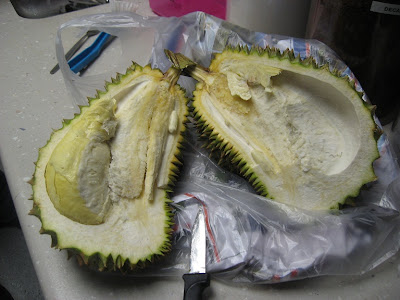
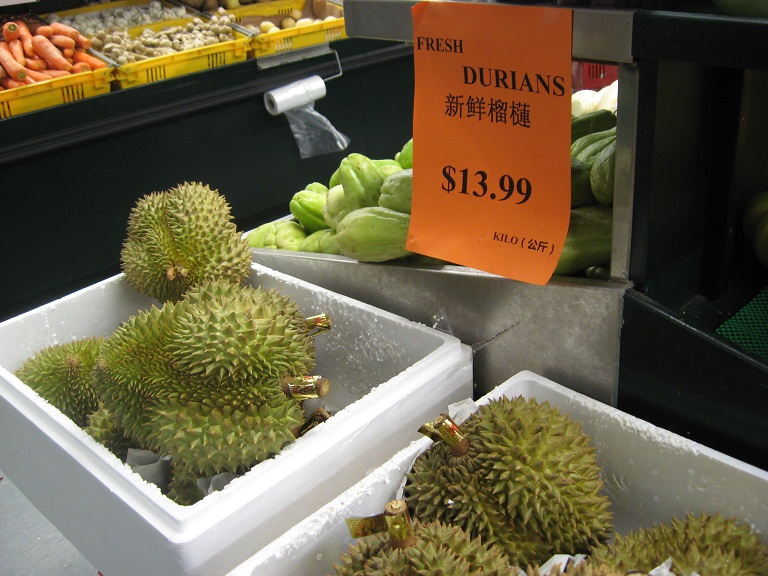
Okay, so durian is not so much a dish as an exotic fruit.  Frozen durian can help satisfy a strong craving for its fragrant flesh, but nothing beats the taste of a fresh creamy durian.  Widely known as the King of Fruits in Southeast Asia, it is probably considered more a Tyrant of Fruits by those who dislike its strong odour and unusual flavour.  You'll never know if you are a lover or a hater of this plant till you give it a try, so round up your friends for a culinary feast (to share the fun, and because you will never get through a whole durian by yourself).

Knowing durian is in season and acting on a tip, I could already smell my target before I entered the fruit shop housing it.  After picking out a 2.5kg specimen (shipped over from Thailand) and getting it wrapped in newspaper, I placed it in the boot of my car for transportation.  I should have thought to bring plastic ziploc bags with me, because I could smell it in my car for a week after I brought it out for slaughter.  Having the beautiful, spiky ball in my hands was worth it though.
Fresh durians for sale in Newmarket
My durian, cut open
And the verdict?  This durian tasted just like the durians we ate in the streets of Kuala Lumpur, but there were some crunchy bits along with the soft, gooey goodness.  I am guessing I should have given it an extra few days to ripen before consumption.

Available for $13.99/kg at
Song Kee Fruit & Veges
5-11 Kent Street, Newmarket, Auckland (that one way bit under the Rialto carpark, opposite the Newmarket Plaza food court)
(09) 520 6288

Fresh Roti Canai

I've been told there are a couple of places in Auckland where you can buy fresh roti canai, spun out on order in front of your eyes.  I've only been to Tastes of Malaysia in Manukau, and I don't need to go anywhere else, because the roti canai here are exactly how I expect them to be, soft and layered, with some crusting on the outside.

Roti canai with Chicken Curry, served on a plastic banana leaf plate with a small salad garnish on the side
The only disappointing thing is that they were rather slow to arrrive.  Friends who ordered the mamak mee goreng got their meals first.  A very hungry friend looked on jealously and quickly ordered a mee goreng of his own, which still arrived before the roti he had previously ordered.

I should also point out that this place is in a food court, but since when has ambience been an issue in the pursuit of good food?

Roti canai being spun out
Available for $4 - $12 at
Tastes of Malaysia
"Food Junction" foodcourt, 615 Great South Road, Manukau, Auckland
 (09) 262 2066

Banana Leaf Rice

The first time I was introduced to banana leaf rice in the outskirts of Kuala Lumpur, I was blown away.  Eating off a banana leaf was quite a novelty on its own, but having a whole range of vegetarian side dishes to accompany your dhal/gravy on rice was even better, especially when I discovered that all those exciting options (deep-fried bitter melon slices were my favourite) could be topped up endlessly, all for the equivalent of about NZD$2.

On my more recent trip to KL, we only managed to find a banana leaf rice place in the upmarket suburb of Bangsar.  The food was equally delicious, with seemingly more meat and fish options, but you had to pay extra for top-ups of side dishes, which included deep-fried okra, leafy greens and cucumber chunks in yoghurt.  Some friends had the optional chicken rice and extra meat dishes, and we all had a refreshing lime drink, making for a most satisfying meal.

When I discovered a restaurant in Auckland offering banana leaf rice, I just had to give it a go.  The first thing that was different compared to my Malaysian experiences was that containers of food were placed in the middle for you to serve yourself, rather than having someone come around and dish up each option.  In both cases you have control over how much goes onto your banana leaf plate, but I guess in the NZ version, you could end up with wasted food at the centre of the table, and presumably the labour costs in Malaysia are much lower.

Another difference was that you could eat as much as you wanted.  Not just the rice and side dishes, but also the chicken and lamb curry mains (sorry vegos, you have to make do with the sides, unless you want to pay extra).  I've always felt somewhat shortchanged at all-you-can-eat places, mostly because I don't eat that much, and I can think of other places where you could have done better for less.  Well, I don't know of any other banana leaf rice restaurants in Auckland, but it felt a little bit more expensive than I expected anyway.

Although the food tasted good at Santhiya's, the most interesting bits were missing from their banana leaf Sunday Special.  You got a poppadom, but no pickles or salted chilli.  You got side dishes, but they were braised cabbage, grated carrot in a sweet vinaigrette, lentil and potato dhal, and a kind of chutney; I missed the deep-fried curiosities, the dark leafy vegetables, the unusual flavours of unidentified ingredients.

Side dishes for banana leaf rice at Santhiya's
Not the best picture of banana leaf rice
Whatever its shortcomings, though, I am glad to have found a banana leaf restaurant in Auckland.  It brings back pleasant memories, and it is always great to have more diversity in the food scene.

Available for $16 (lunch) or $19 (dinner) on Sundays only at
Santhiya's
1270 Dominion Road, Mount Roskill, Auckland
(09) 620 2986
Mondays closed.
Tuesdays to Sundays 11:30am - 3pm and 5 - 9pm
Related Posts Plugin for WordPress, Blogger...