Showing posts with label Ethnic Sweets. Show all posts

Wednesday, August 8, 2012

Failing to Fast (and Panda Exposed)

It's been known for years, and mentioned more recently in BBC News, that fasting, or going without food for short periods of time, is actually good for you.  Not only does calorie restriction help you lose weight, but it has been shown to extend your life expectancy.  Researchers are now looking into the benefits of an Alternate Day Fasting diet, in which you eat whatever you like for one day, but have a very restricted diet the next, 500 - 600 calories a day depending on whether you are a woman or a man.

It doesn't actually sound too terrible.  Muslims around the world are currently fasting daily between sunrise and sunset, and they are not even drinking water in that time.  I had forgotten this fact until I returned to Holy Land Foods last evening, and saw the restaurant transformed.  There were bowls of dates on every table, and at the front of the room there was a veritable feast, with an assortment of Middle Eastern desserts on multiple platters.  "It's Ramadan," explained chef-owner Abrahim, as he smiled at the surprised look on my face.

An unbelievable amount and variety of desserts for Ramadan.

Now, I'd only meant to have a light salad for dinner, but I just couldn't resist trying all the new and unusual items on offer.  And so, in addition to the fattoush (فتوش), I ordered a selection of sweet treats: basbousa (بسبوسة), a warm semolina cake; qatayef (قطايف), a semi-circular dumpling filled with cream and sprinkled with nuts; and awwamat or awamat (عوامات), fried dough balls drizzled with sugar syrup.

Fattoush is a salad topped with crispy bread.  This one included cucumber, tomato, radish (I love radish!) and onion.

Basbousa, qatayef, and awwamat.
Apparently the latter literally means "buoys" in reference to the way in which these balls float to the top of the hot oil while cooking, and this is the term used in the Arabian Gulf.  In Egypt, they are called lokmet el adi or luqmat al-qadi (لقمه القاضى), meaning "judge's snack" (a light meal rather than the literal translation of "mouthful", according to blogger Coptic Dad and Mom.  It is a metaphor for judges being rich people who didn't eat the commoners' bread, adds the Naked Plate Blog.)  Despite the stories behind the name, my favourite dessert here is still the konafa (كنافة) which I praised in my previous post.

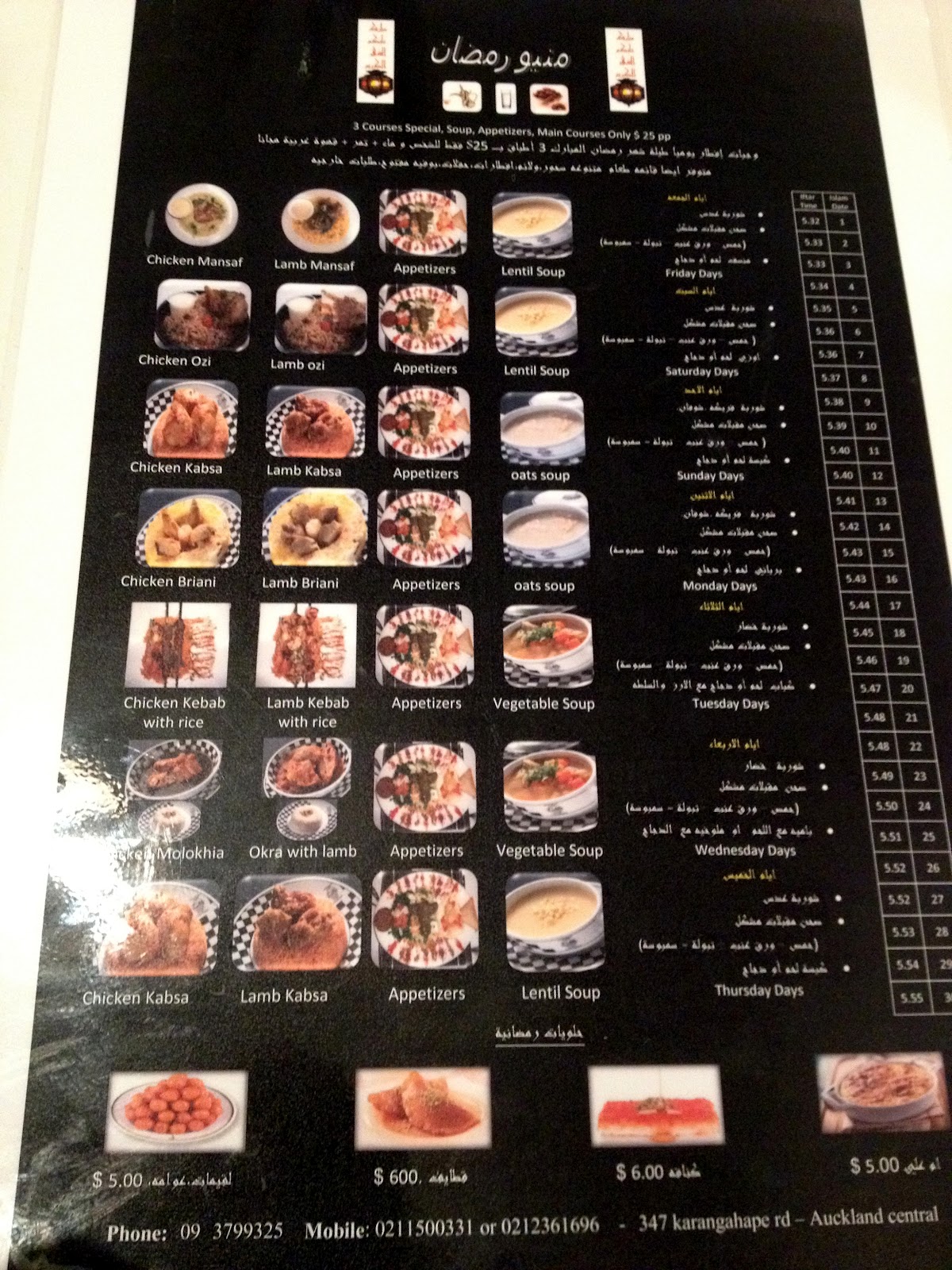
Holy Land also had a special menu for the month of Ramadan (today is day 19 already, and it only goes to day 30, so hurry if you want to try it!), with a set menu for each day of the week, three courses for $25 (choice of chicken or lamb for the main dish).  Abrahim saw me taking a picture of this menu, and asked if that was really what I was doing.
Me (guiltily): Yes.  Is that okay?
Abrahim: Are you the person who took pictures of our food and put it on the internet?
Me: Yes.  Uh-oh, busted.  Is that okay?
Abrahim (smiling): Of course. Thank you.  Thank you for doing that.
Phew!  With that blessing, I hereby present the Ramadan Menu at Holy Land.  Although I did not manage to have it last night, I can highly recommend the lentil soup they make.  There are a few other things I would love to try too.  And you can still order off their normal menu.  Just be aware that their opening hours are 3pm - 1am for this special month (maybe subtract an hour or so on each end to be on the safe side), before going back to 9am - 9pm after the end of Ramadan.

Ramadan menu at Holy Land Foods.

Saturday, March 31, 2012

Sohan (سوهان) or Iranian Saffron Brittle @ Persian Network *CLOSED*

[Added 30 January 2017: Note that Persian Network closed several years ago amidst accusations of fraud]

There was an Iranian girl in my class at primary school.  She was loud and cheeky, and I didn't try very hard to get to know her, but I admired the flowing lines of the Arabic script on her plastic stencil ruler.  I didn't understand how she could tell the characters apart, because they looked nearly the same to me.  I also discovered that her language was called Farsi, not Iranian, and you write it from right to left.  That was the extent of my knowledge of her world.

And so it was that when I came across Persian Network, one of the many interesting shops on Dominion Road, I wondered why it was painted in the Italian colours of green, white, and red.  As you might have guessed, it wasn't becaused someone had confused Iranian with Italian.  When the tri-color stripes run horizontally rather than vertically, that is in fact the Iranian flag.

This shop isn't crammed full, but there is a good range of things for sale, from sweets, breads and spices, to rugs, trinkets and utensils.  As you can tell from their website, they are not dumbing things down for tourists like me.  Although there is an English label for most things, you need to use your powers of deduction to work out that the reddish powder labelled "dried nuts and fruits" is in fact sumac, and the box of confectionery made of sugar, egg whites, rose water and pistachios holds Persian nougat, or gaz (گز).

I decided to purchase a beautiful tin box containing what looked like crunchy biscuits, which the Iranian owner warned me would be very sweet.  This dessert, called sohan (سوهان) is essentially a brittle toffee made of wheat sprouts, saffron, flour, sugar, pistachios, butter, cardamom, egg yolks, and rose water.  Not unexpectedly sweet, but quite oily or syrupy.  Somehow, it manages to be crumbly and leave a chewy lump stuck to your teeth at the same time, an enjoyable mix of flavours and textures.

Sohan in a detailed and embossed tin.
From what I can see, I have purchased sohan qom (سوهان قم), which is primarily produced in the city of Qom and is a common souvenir from the place.  It is quite different from sohan asali (سوهان عسلي), a honey-based toffee usually with slivers of almond, which is a harder and shinier candy, often eaten for Nowruz, the Iranian New Year.  A variant of the honey-almond toffee is sohan konjedi (سوهان کنجدی), which instead has sesame seeds set in the honey and saffron translucent brittle.

Does anyone have a recipe for this delicious sweet, or shirini (شیرینی) which I have bought? The closest one I could find on the web is in this video from a TV cooking show, which makes use of honey and corn syrup in addition to sugar, but no egg yolks.  It also uses whole wheat flour instead of wheat sprouts, if indeed that was the correct translation.  According to this video of sohan qom production, the brittle shouldn't stick to your teeth either.

Whatever the secret, this is why I love living in Auckland, having the opportunity to taste exotic flavours from around the world without needing to leave the country.  I am looking forward to tomorrow too, not because it will be April Fools' Day, or because Daylight Saving will be over (yay for an extra hour's sleep), but because the Auckland International Cultural Festival will be on (bring on the Ethiopean, Croatian and Burmese food!).

Store Details

Persian Network
1/718 Dominion Road, Mount Eden, Auckland
(09) 623 0070

Persian Network is on the corner of Balmoral Road and Kensington Avenue.
Related Posts Plugin for WordPress, Blogger...