Monday, August 1, 2011

Notes: Diet and Obesity: down a road less travelled

I'm interested in food in lots of ways.  I like knowing where I can eat great meals, I enjoy understanding the science behind how dishes are made (though not enough to purchase a copy of Nathan Myrvold's 5+ volumes of Modernist Cuisine), and I also care about the effect of food on my body (not that it stops me from indulging in fries far too often).  In the first lecture of the 2011 Vice Chancellor's Lecture Series: Good Food, Good Health held last Thursday, Professor Mike Gibney, Professor of Food and Health at University College Dublin, explored issues around obesity which are not often discussed.  I thought I'd put a summary here, in case anyone else was interested.

1) People are putting on more and more weight, but this increase is not linear
Two groups of people were studied over two different periods in time.  In both cases, their average Body Mass Index (BMI) increased over time, but this was not in a straight line.  Rather, it plateaued before increasing again, as shown below. I'm not too sure what the significance of this is, and it was not explained why this happened, so I will skip over this one.

2) Fidgeting can improve your cardiovascular fitness and help with weight loss
I don't know about you, but the only time I've gone to a gym was when I bought membership for a semester while at university, and I never managed to work out.  I looked around, decided it was all too hard, and never made it back again.

It's important to be fit though. Fat people who exercise have better cardiovascular fitness than thin people who just sit around.  And apparently, the risk of mortality is the same for fit people, regardless of whether they are overweight or not, while the risk of type 2 diabetes increases for sedentary people.

Fortunately, we don't necessarily need to go to the gym.  Minor activity that we don't consider exercise, such as walking to the water cooler, can also be beneficial.  Dr. James Levine of the Mayo Clinic investigated the role of this incidental activity, or NEAT (non-exercise activity thermogenesis), in reducing fat gain.

Even when we are not doing what we consider physical activity, we are expending energy.  It takes energy to digest and absorb food.  Resting energy makes up about 85% of where our calories go, while physical activity accounts for only 12 - 15%.  The rest is consumed by non-exercise activity that we can call fidgeting.

ActivityEnergy expended (kJ/min)
Sleeping5.4
Sitting motionless5.6
Sitting fidgeting8.2
Standing motionless6.1
Standing fidgeting10.3
Walking (stop/start)13.7
Walking (stroll)16.4

A study found that fat people who were slimmed down sat still more than naturally lean people.  In another study, non-obese subjects were overfed 1000 kcal/day for 8 weeks, with restrictions on what they could do.  Those who gained more weight were those who did less non-exercise activity.

Over the past 50 years, people have shifted away from work in production and agriculture, towards service jobs, which have become more and more sedentary.  Maybe we can address this by encouraging ourselves to move more, even in minor ways.  (Another great idea which wasn't discussed in the lecture, but which I have read elsewhere, is making sure you get enough sleep, since you are still burning calories, while not being tempted by food, when you are sleeping.)

3) Nature vs. nurture: your genes interact with your environment in influencing your weight
There isn't one gene for obesity, but multiple risk alleles.  Some researchers narrowed these down to looking at 5 genes, and tested 101 Caucasian women for 3 genotypes after randomly assigning them diets over a year:
  • low CHO responsive genotype
  • low fat genotype
  • balanced diet genotype
They were able to predict weight loss for those who had been assigned the right diet for their genotype.

In another study, children were followed from the age of 4 to the age of 11.  In the children of non-obese parents, the environmental factors seemed to make little difference.  They were lean whether they belonged to a poor family or not.  However, children of obese parents were much more likely to be obese if they also had a lower social economic status.


The take-home message is that we shouldn't blame our weight on our genes, and give up on eating well, though genetics certainly play a role.  Rather, we can apply science to target an optimal diet for the genes that we have.

4) The Pinocchio factor: food intake is often under-reported to researchers, adding complexity to any study
In dietary surveys, energy under-reporting ranges from 30% - 50%.  This applies not just to "bad" foods, but anything the subjects have been eating.  Females are more likely to under-report, overweight females more so, and smoking overweight females even more so.

Misrepresentation can occur in three different ways:
  • Denial, e.g. "I never eat chocolate"
  • Frequency, e.g. "I only eat chocolate at Easter"
  • Portion, e.g. " I only have a small square of chocolate"
It is diffiicult to know which foods have been lied about, and which form of falsehood has been used.

5) Reflections and projections
There are four challenges in the fight against obesity:
  • Prevention of initial weight gain
  • Prevention of progressive weight gain
  • Managing the metabolic syndrome
  • Maintaining weight loss

Obesity is often politicised.  For instance, if 20% of professionals and 30% of unskilled workers are obese, this would be reported as "obesity rate 50% higher in unskilled workers".  These statistics are much less dramatic if you look at them from the opposite view: 80% of professionals and 70% of unskilled workers are not obese.

People will make sweeping statements against fast food giants like McDonald's.  But why? Is it because chips are bad for you?  If so, shouldn't the corner cafe or local fish and chip store, which also sell chips, also be banned?

Any public policy to address obesity will require long term planning, not random rules based on irrational fears.

Saturday, July 23, 2011

Review: Vinyl Coffee Shop

Whenever I return to Auckland from Wellington, I am thankful for the range and quality of the Asian food available in New Zealand's largest city, but somewhat disappointed by the lack of cafes which match the calibre of those the capital.

Well, one little gem goes somewhat towards alleviating that void: Vinyl Coffee Shop, with its posters on the wall, handwritten chalkboard signs and offerings for both meat-eaters, vegetarians and vegans, has exactly that feel I associate with arty types and students. There's a bit of bare brickwork on one wall, naked lightblubs, giant Jaffas in a jar on the counter, and little knick-knacks on the tables: a bear-shaped glass here, a mini air hockey table there.

Vinyl is a little place with a laid-back, hipster feel
This little place only has eight tables (three small ones and three larger ones inside, and two tiny circular tables outside), so it's not surprising that it's often full, especially since that wee kitchen somehow manages to create some good food.

This morning, we had the cheese burger with curly fries, served in ciabatta bread because they'd run out of hamburger buns.  The lamb pattie was perfectly cooked, soft and juicy in the middle.  There were rocket leaves in the burger and we even found a lemon pip as evidence that they made their own mayonnaise.  The fries were also delicious, golden and crispy.

Cheese burger, with lamb pattie, tomato, avocado, rocket, homemade mayonnaise and curly fries
You get to feel good too.  Apart from catering to vegans with tofu and vegetable options, Vinyl uses free range eggs and free range streaky bacon.  We'll overlook the fact that their curly fries are imported from Canada.

My main complaint is that they close too early---don't come here if you are looking for a late lunch, as the kitchen is only open till 2pm in the weekends.  Also, eggs don't really belong in a burrito, and it would be nice if they offered a side salad.  Otherwise, we love this place!

Panda Recommends

Mains: Cheese Burger ($14, or $16 with curly fries) [Added 29 June 2013: you can also ask for this medium-rare]
Sides: Curly Fries with Mayo ($5)
Avoid items with scrambled eggs, such as the Spanish eggs, or the breakfast burrito - somehow it ends up bland and rubbery.

Vegie Pandas
Vegetarians and vegans alike can rejoice.  From the Tofu Scramble to the Vege Stack, this cafe has definitely got something for you.

Menu - page 1
Menu - page 2
Restaurant Details

[Added 10 January 2016: Vinyl has now moved into the same space as its sister restaurant Ralph's, around the corner with the entrance on Walters Road, where Serafin used to be.]

Vinyl Coffee Shop
218 Dominion Road, Mount Eden, Auckland
(09) 623 3821
vinylcoffeeshop@gmail.com

Opening hours:
Mondays to Fridays 7am - 3:30pm
Saturdays to Sundays 9am - 3pm

Vinyl is a little cafe on Dominion Road


View Nom Nom Panda in a larger map

Sunday, July 17, 2011

Review: Genzui Ramen Bar

Whenever we are at a loss as to what to eat for lunch, we always seem to end up at the same place: a sleek little eatery called Genzui, tucked away off the street.  The food is good, the prices are reasonable, and there is something for everyone, from vegetarians to those avoiding carbs.

Genzui is a popular lunch venue
Despite calling itself a ramen bar, there is actually plenty on offer other than these wheat noodles. You can order dishes on rice, as well as purely meat-based ones, or salads (with or without meat) for those looking for a vegetable fix.

Apart from the broth in the ramen bowls sometimes being a little too salty, the only disadvantage of choosing this place for a meal is that it is always full at lunchtime! Turnover is quick, however, and we have never had to wait more than a few minutes before finding a seat (though we do also try to avoid the peak hour).

As with most Asian restaurants, don't expect all the dishes to arrive at the same time.  Tuck in as soon as a dish is brought out, and enjoy!

Autumn special: Miso Butter Corn Ramen

Spicy Chicken Don
[Added 4 August 2011:

We had dinner at Genzui tonight, as we were rushing to get to the lecture on carbohydrates at the university.  I asked what the meaning of Genzui was, and was told that it is the name of the owner's son.  This owner is also the the owner of Mentatz, that Japanese eatery on Lorne Street that is hugely popular with students.  The waitress pointed to a chef in the kitchen as she mentioned him.  This guy knows how to get his hands dirty!

Oh, and you can indulge your inner health freak by ordering extra vegetables.  The mini salad only costs $2 and comes with a dob of Japanese mayonnaise and a light vinaigrette.   I don't know how they chop the cabbage so thinly... I have never managed it at home.  I guess I am easily impressed.  :)

Mini salad, with salmon sashimi in the background
]

Panda Recommends

Mains: Chicken Miso Katsu Don ($9.50), though most other dishes are good too, so just order whatever takes your fancy.  I prefer the don dishes here, while the ramen seem to be better at Genzui's sister restaurant Mentatz.

Vegie Pandas
The Vege Ramen is probably not for you, unless you are happy with chicken stock in your soup.  There are some tofu dishes (e.g. Curry Tofu Don, Tofu Steak) and suitable side dishes and salads, though.

Menu - page 1
Menu - page 2
Restaurant Details

Genzui Ramen Bar
128 Albert Street, Auckland Central (foyer of the Crowne Plaza Hotel)
(09) 358 0240

Opening hours:
Mondays to Fridays 11:30am - 10pm
Saturdays to Sundays 6pm - 10pm


Genzui is situated in the foyer of the Crowne Plaza Hotel.  Go down the escalators, right to the bottom, and you will reach the Atrium on Elliott foodcourt.


View Nom Nom Panda in a larger map

Wednesday, July 6, 2011

Free Food Lectures @ The University of Auckland

I don't often read those newsletters from my alma mater, but this month, something caught my eye.  For four Thursdays from the end of the month, there will be a lecture given on a food-related topic as part of the Vice Chancellor's Lecture Series: Good Food, Good Health.

The titles look pretty interesting, especially the third one, so I've signed up for double tickets to all of them already.  Check them out!

28 July - Diet and obesity: down a road less travelled
4 August - Carbohydrates: friend or foe?
11 August - Myths, molecules and 5% magic
18 August - The fetus and newborn: critical gourmands

Flyer - page 1

Flyer - page 2

Thursday, June 30, 2011

Still Missing Malaysia

Thanks to various bloggers, I've discovered that some specialties available in Malaysia, which I thought weren't available in Auckland, can actually be found here.  Things like fresh durian, fresh roti canai and banana leaf rice,which I'll go into in a minute.  And though I have yet to see another establishment sell a kaya toast set here since the demise of Kaya+Toast (mentioned in my previous post), it is pretty easy to create it yourself at home.  What I absolutely don't have information on, though, is the dish that my friends roundly regarded as our best meal in Malaysia: beef ball noodles from a stall in the basement of the Lot 10 shopping complex.  Not only have I failed to find a place which sells this in Auckland, but I have failed to find a recipe for it on the web, though there were plenty of photos in the search results.

A half-eaten beef ball noodle set.  The noodles were pale yellow to begin with and came with vegetables which also had a dark sauce on top.

"What do you mean", I can hear you asking.  "I've seen plenty of places around selling beef balls and noodles."  Well, yes, but they aren't the same beef ball noodles.  What you are probably talking about is beef ball noodle soup.  These were dry noodles, with a combination of two dark sauces ladled over the top, the secret ingredients of which I would dearly love to know.  I am pretty sure that the lighter of the two was made of minced pork, and I found something in the Asian grocery store which resembled the contents of the darker sauce: Chinese olives preserved with vegetables (gan lan cai, olive vegetable or 橄欖菜 on the label).  But what have they done with these things to make the sauces taste the way they do?

I'd rather dwell on my successes, so let me tell you about the dishes that I have managed to find...

Fresh Durian

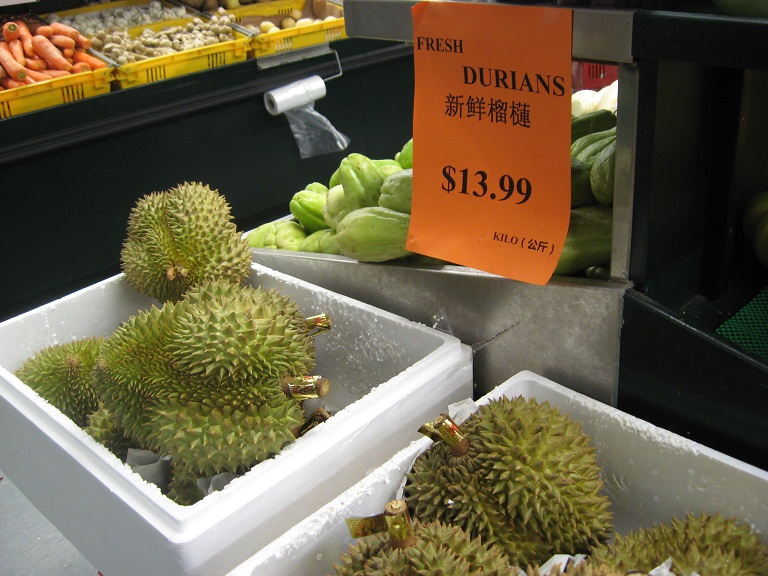
Okay, so durian is not so much a dish as an exotic fruit.  Frozen durian can help satisfy a strong craving for its fragrant flesh, but nothing beats the taste of a fresh creamy durian.  Widely known as the King of Fruits in Southeast Asia, it is probably considered more a Tyrant of Fruits by those who dislike its strong odour and unusual flavour.  You'll never know if you are a lover or a hater of this plant till you give it a try, so round up your friends for a culinary feast (to share the fun, and because you will never get through a whole durian by yourself).

Knowing durian is in season and acting on a tip, I could already smell my target before I entered the fruit shop housing it.  After picking out a 2.5kg specimen (shipped over from Thailand) and getting it wrapped in newspaper, I placed it in the boot of my car for transportation.  I should have thought to bring plastic ziploc bags with me, because I could smell it in my car for a week after I brought it out for slaughter.  Having the beautiful, spiky ball in my hands was worth it though.

Fresh durians for sale in Newmarket
My durian, cut open
And the verdict?  This durian tasted just like the durians we ate in the streets of Kuala Lumpur, but there were some crunchy bits along with the soft, gooey goodness.  I am guessing I should have given it an extra few days to ripen before consumption.

Available for $13.99/kg at
Song Kee Fruit & Veges
5-11 Kent Street, Newmarket, Auckland (that one way bit under the Rialto carpark, opposite the Newmarket Plaza food court)
(09) 520 6288

Fresh Roti Canai

I've been told there are a couple of places in Auckland where you can buy fresh roti canai, spun out on order in front of your eyes.  I've only been to Tastes of Malaysia in Manukau, and I don't need to go anywhere else, because the roti canai here are exactly how I expect them to be, soft and layered, with some crusting on the outside.

Roti canai with Chicken Curry, served on a plastic banana leaf plate with a small salad garnish on the side
The only disappointing thing is that they were rather slow to arrrive.  Friends who ordered the mamak mee goreng got their meals first.  A very hungry friend looked on jealously and quickly ordered a mee goreng of his own, which still arrived before the roti he had previously ordered.

I should also point out that this place is in a food court, but since when has ambience been an issue in the pursuit of good food?

Roti canai being spun out
Available for $4 - $12 at
Tastes of Malaysia
"Food Junction" foodcourt, 615 Great South Road, Manukau, Auckland
 (09) 262 2066

Banana Leaf Rice

The first time I was introduced to banana leaf rice in the outskirts of Kuala Lumpur, I was blown away.  Eating off a banana leaf was quite a novelty on its own, but having a whole range of vegetarian side dishes to accompany your dhal/gravy on rice was even better, especially when I discovered that all those exciting options (deep-fried bitter melon slices were my favourite) could be topped up endlessly, all for the equivalent of about NZD$2.

On my more recent trip to KL, we only managed to find a banana leaf rice place in the upmarket suburb of Bangsar.  The food was equally delicious, with seemingly more meat and fish options, but you had to pay extra for top-ups of side dishes, which included deep-fried okra, leafy greens and cucumber chunks in yoghurt.  Some friends had the optional chicken rice and extra meat dishes, and we all had a refreshing lime drink, making for a most satisfying meal.

When I discovered a restaurant in Auckland offering banana leaf rice, I just had to give it a go.  The first thing that was different compared to my Malaysian experiences was that containers of food were placed in the middle for you to serve yourself, rather than having someone come around and dish up each option.  In both cases you have control over how much goes onto your banana leaf plate, but I guess in the NZ version, you could end up with wasted food at the centre of the table, and presumably the labour costs in Malaysia are much lower.

Another difference was that you could eat as much as you wanted.  Not just the rice and side dishes, but also the chicken and lamb curry mains (sorry vegos, you have to make do with the sides, unless you want to pay extra).  I've always felt somewhat shortchanged at all-you-can-eat places, mostly because I don't eat that much, and I can think of other places where you could have done better for less.  Well, I don't know of any other banana leaf rice restaurants in Auckland, but it felt a little bit more expensive than I expected anyway.

Although the food tasted good at Santhiya's, the most interesting bits were missing from their banana leaf Sunday Special.  You got a poppadom, but no pickles or salted chilli.  You got side dishes, but they were braised cabbage, grated carrot in a sweet vinaigrette, lentil and potato dhal, and a kind of chutney; I missed the deep-fried curiosities, the dark leafy vegetables, the unusual flavours of unidentified ingredients.

Side dishes for banana leaf rice at Santhiya's
Not the best picture of banana leaf rice
Whatever its shortcomings, though, I am glad to have found a banana leaf restaurant in Auckland.  It brings back pleasant memories, and it is always great to have more diversity in the food scene.

Available for $16 (lunch) or $19 (dinner) on Sundays only at
Santhiya's
1270 Dominion Road, Mount Roskill, Auckland
(09) 620 2986
Mondays closed.
Tuesdays to Sundays 11:30am - 3pm and 5 - 9pm

Sunday, May 29, 2011

Review: Mamak (or Missing Malaysia)

We've just come back from a short and spontaneous trip to Kuala Lumpur—who could say no to a return fare of NZ$730 per person, when cheap, delicious and exotic meals awaited at the other end?

Street food such as satay was definitely on the menu, and we were particularly happy to find whole durian stalls on Jalan Alor, where the fresh creamy fruit with its spiky exterior was cut up in front of you for immediate consumption.  Other quests we went on were not so successful, and after many hours wandering the streets of Little India, we finally had to consult the internet to find out where to go for banana leaf rice.

Delicious food could also be found in the food courts of the malls in KL (a strange idea for someone used to NZ shopping malls), and it took a great amount of will power not to overeat on a daily basis.  Apart from the range of dishes available from the Malay, Indian and Chinese Malaysian kitchens, we took delight in the Western fast food chains that existed, both because of the retailers that do not exist in NZ (Papa John's Pizza and Krispy Kreme Doughnuts, for instance), and because of the novel menu items offered by the more familiar franchises (chicken rice or Portuguese egg tarts from KFC, anyone?)

We've noticed that Malaysians like their hot chillies, and also have their drinks very sweet (they even add sugar syrup to fruit juices!), but probably more than anything else, what really defines Malaysian food culture are the mamak stalls and kopitiams.  In the former, you can purchase roti canai (soft and flaky flatbread), served with dhal for RM1.00 (about 50c in NZ), and more interesting varieties such as roti telur (with egg filling) or roti pisang (with banana filling) for RM2.00 (NZ$1); in the latter, you can have a breakfast of kaya toast (toast with coconut jam and often butter sandwiched in the middle), soft-boiled eggs (cracked into a dish and eaten with white pepper and soy sauce) and teh/kopi (local tea/coffee, sweetened with condensed milk—append "O" as in "teh-O" to have it without milk and append "C" to have it without sugar), for maybe RM8.00 in a set or combo.  Here's a video showing the amazing skill involved in making roti canai, though many places have the plain version made ahead of time:

On the topic of roti, we really learnt the generic meaning of the word when we went to order roti kaya, thinking that it would be a roti canai with filling, as is the case with roti bawang, roti pisang, etc.  We were disappointed to receive kaya toast made of white sandwich bread, rather than the Malaysian Indian bread we were hoping for.  Only then did we remember the roti john, which is made with something like hamburger buns, and the roti tissue, a paper-thin crispy sweet pancake shaped into a cone.

After all this fevered eating, we are back home, ready or not.  Auckland has some good Malaysian restaurants: you can never get a seat at KK, and everyone raves about the Fish Noodle Soup at Sri Mahkota.  Unfortunately, the only place I knew here that served kaya toast was in the IMAX food court, and that closed about nine months ago.

Kaya + Toast Coffee Hub used to be a great place for absorbing Malaysian/Singaporean culture
It was with great excitement that I heard from a friend about a new place in town called Mamak, which opened in the Chancery, towards the beginning of the year. As you would expect from a place with such a name, they have many types of roti, including the sweet varieties I had learnt to love in Malaysia.  The prices here are slightly higher than in a food court such as Food Alley, but for that you get to eat al fresco in the cobbled courtyard of an upmarket complex, the food is beautifully presented, and the owner comes rushing out to put up an extra umbrella for you should it get too sunny or rainy.

I guess you would call the food modern Malaysian, since there are raw salads served with some of the side dishes (labelled "tapas"), a lot of attention has been paid to the visual impact of the plates, and the menu caters well to vegetarians.  For this reason, I am going to forgive them for the fact that the roti canai is not quite the texture I have come to expect, almost too crispy and oily, rather than soft with a flaky crust (I thought this may have been intentional, but they have taken the hard crispiness out of the roti now).  I also found the dhal accompanying the roti somewhat bland, but other dishes, like the nasi lemak or mee goreng, had great flavours, and items like pandan soy bites I just have not seen for sale anywhere else.

[Added 14 January 2012: I have since since seen "deep fried chickun in pandan leaf" for sale at Loving Hut, formerly the Golden Age Vegan Restaurant (61 Victoria Street West, diagonally opposite the Sky Tower).]

Nasi Lemak with Beef Rendang
Mee Goreng
Roti Tissue, thin and crunchy with a sugar lining, served with condensed milk, curry and cabbage
In any case, Mamak is good enough for my workmates, including the Malaysian/Singaporean ones, to eat at on a weekly basis.  From a quiet start, this eatery has attracted more and more of the lunchtime crowd, to the point where people were being turned away because there weren't enough tables.  They no longer take lunch bookings, but I guess we kind of have a standing appointment with the owner, whom we secretly refer to as "Uncle Jeffrey".  Give this place a try, if you can find a seat.

Panda Recommends

Mains: Mee Goreng ($13.50), Nasi Lemak ($12.50)
Sides/Dessert: simply for its novelty value, Roti Tissue ($7.50)

Vegie Pandas
Vegetarian items are clearly marked on the menu, but there are some non-marked items that you could also have, for instance the sweet roti varieties and the plain murtabak.  The fish/chicken gravy accompanying other roti options could also be replaced by an extra portion of dhal (not particularly exciting), or sometimes vegetarian curry.

[Added 13 May 2013: The menu below is old. Apparently you can only get roti tissue in the weekends these days.]
Menu - Page 1
Menu - Page 2

Restaurant Details

Mamak
Chancery Square, 50 Kitchener St, Auckland Central
(09) 948 6479

Opening hours:
Mondays closed.
Tuesdays to Sundays 11:30am - 10pm

Mamak has lovely courtyard seating in the Chancery


View Nom Nom Panda in a larger map

Monday, April 11, 2011

Review: Serafin Cafe and Bar *CLOSED*

[Added 1 May 2014: Serafin closed on 9 April 2014. However, chef Serafin Bueno Sanz will be opening a tapas bar called Pepitos at the end of this year.]

Tapas restaurants are everywhere these days. The idea of eating a number of small dishes is so prevalent that you even see the term "tapas" being used to describe food of non-Spanish/non-European cultures: for instance, Japanese restaurant Soto has a section of their menu labelled "Japanese tapas", and Indian restaurant Arun's offers "a mouth watering tapas selection" according their website, even though the word is not used on their menu. I love tapas in any case, because you have the opportunity to sample a variety of items without feeling as though you are ordering too much.

A new tapas place opened off Dominion Road, close to Eden Park, a few weeks ago. I have been watching the space with interest for months, as a beautifully designed building was constructed in what used to be part of StereoWorld.  A news article about Serafin's trouble with obtaining a liquor licence gave us a further incentive to eat at this restaurant, to show the owner some local support.

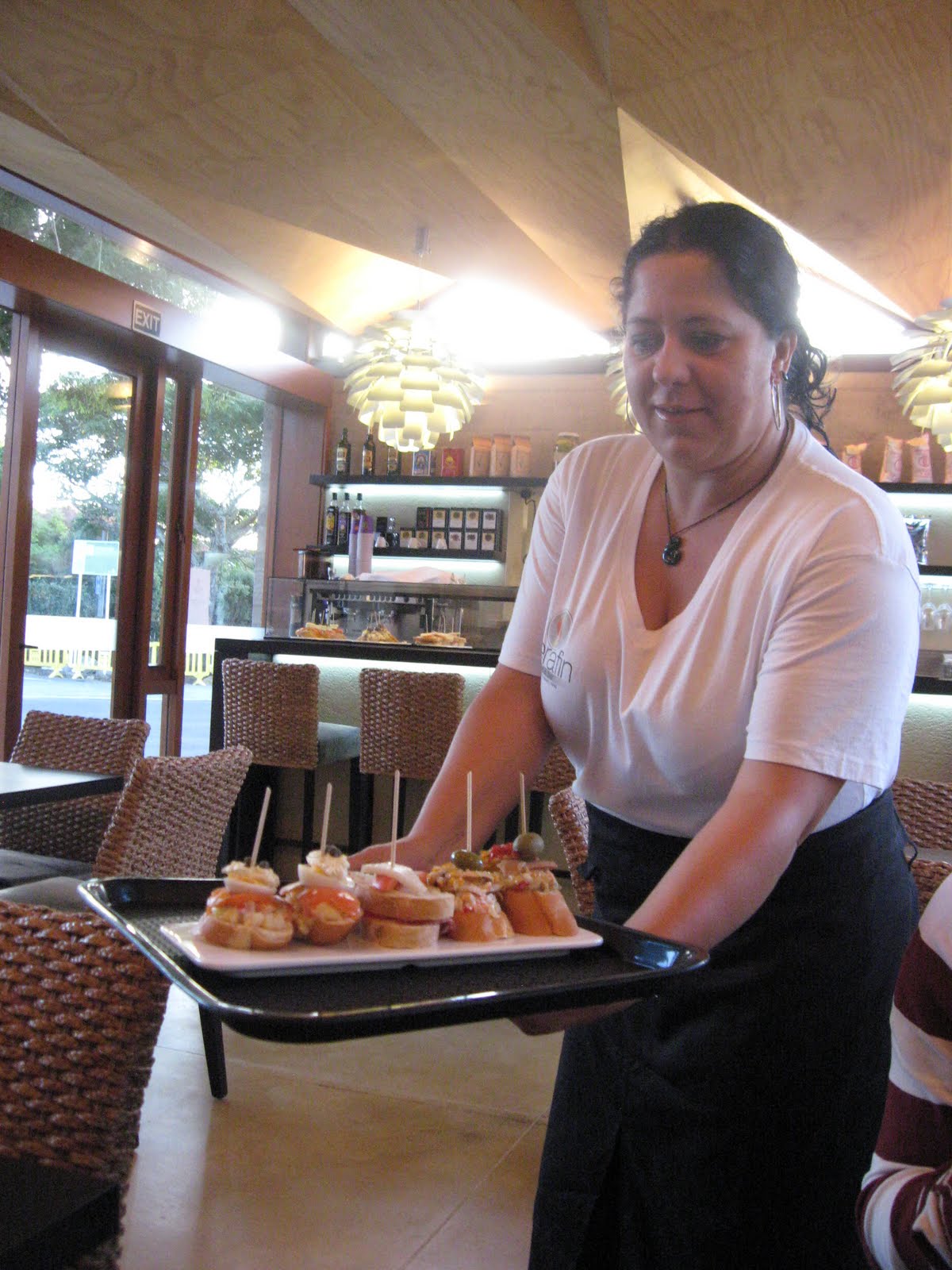
The first time we entered Serafin (presumably named after chef owner Serafin Bueno, who according to Lauraine Jacobs was "the talented Spanish chef who presided over the kitchen of The Regent Auckland hotel back in the 80s"), there were no other customers in the stylish eatery.   The welcoming staff greeted us in Spanish, explained to us what tapas were, somewhat unnecessarily, and offered us drinks and pinchos, which were morsels on slices of bread.  Apparently, the lack of a liquor licence has caused some customers to walk out, and we made sure we signed the petition for it (already with hundreds of names) after our meal, which turned out to be delicious.  It was heartening to see the room fill up somewhat by then too.

Waitress offering us a selection of pinchos
The waitress recommended the paella, and we chose to try the one with clams and prawns, along with various tapas.  It was as tasty as it looked, with a strong seafood flavour, far superior to the paella you can buy at the markets around Auckland.  A plate of bread with tomatoes appeared at our table, and we were wondering if our order was mixed up somehow, before we were told that people always ate tapas with this bread.

Arroz Meloso de Langostinos y Almejas, which we called the seafood paella
Also recommended: Bomba de Chorizo con Salsa de Mojo Verde
The desserts brought us especial delight, and we turned up one weeknight (empty restaurant again) simply for the freshly-made churros with creamy tasting dipping chocolate and the "very Spanish" dessert of torrijas, which is a bit like bread and butter pudding but is made with red wine.  We returned for a third time in two weeks with friends in tow (restaurant fuller on a weekend), and finally tried the crema catalana, which almost surpassed the previous fantastic desserts with its smooth custard and delicate lemon flavour.

Chocolate con churros

Torrijas, topped with vanilla icecream
In short, bring your friends for a meal at Serafin, and make sure you leave room for dessert!  You can practise your Spanish while enjoying the beautiful interior decor or the outdoor courtyard area, and we just know this little place is going to be chock-a-block full during the Rugby World Cup.

Panda Recommends

Tapas: Bomba de Chorizo con Salsa de Mojo Verde (Potato balls with chorizo and Mojo Verde sauce, $10.00)
Mains: Arroz Meloso de Langostinos y Almejas (Spanish rice casserole with prawns and clams, feeds two people, $42.50), Doble Cocion de Pato com Lentejas y Paprika Ahumada y sus Verduritas (two ways of cooking duck confit with lentils, smoked paprika, vegetables and sherry vinegar, $21.00), Chilindron de Cordero y Judias Blancas y Cebolla Tierna (Lamb rack casserole with white beans, amontillado sherry and baby onions, $21.00)
Desserts: Crema Catalana (Catalan baked custard, $9.50), Chocolate con Churros (Spanish doughnuts with chocolate sauce, $8.00), Torrijas (marinated bread in red wine, $10.00)

Vegie Pandas
Limited range of main items for vegetarians here, but the desserts are divine.

[Added 17 August 2011:

The menu below is out-of-date. In their updated menu, they have added a marinated salmon dish, and offer a full drinks selection, including Sangría for $9 a glass.  Prices have been revised upwards for some dishes but not for others, which is not a terrible thing as they used to be almost too cheap for the quality of food we were getting, and more people eat here now than ever before.
]
Menu
[Removed 16 July 2011:

Note

Currently you cannot purchase alcohol from this restaurant, but hopefully they will get a liquor licence soon, after the hearing which will be in Wellington on May 19.

]

Restaurant Details

Serafin Cafe & Bar
225B Dominion Road, Balmoral, Auckland
(09) 630 0228
buenoskitchen@gmail.com

Opening hours - winter (updated 29 June 2013):
Mondays closed.
Tuesdays to Thursdays 5:30 - 10pm
Fridays to Saturdays 11:30am - 3pm, 5:30 - 10pm
Sundays 11:30am - 3pm

Serafin opens onto Walters Road, off Dominion Road, next to the Wendy's drive-thru entrance.


View Nom Nom Panda in a larger map
Related Posts Plugin for WordPress, Blogger...