Sunday, May 29, 2011

Review: Mamak (or Missing Malaysia)

We've just come back from a short and spontaneous trip to Kuala Lumpur—who could say no to a return fare of NZ$730 per person, when cheap, delicious and exotic meals awaited at the other end?

Street food such as satay was definitely on the menu, and we were particularly happy to find whole durian stalls on Jalan Alor, where the fresh creamy fruit with its spiky exterior was cut up in front of you for immediate consumption.  Other quests we went on were not so successful, and after many hours wandering the streets of Little India, we finally had to consult the internet to find out where to go for banana leaf rice.

Delicious food could also be found in the food courts of the malls in KL (a strange idea for someone used to NZ shopping malls), and it took a great amount of will power not to overeat on a daily basis.  Apart from the range of dishes available from the Malay, Indian and Chinese Malaysian kitchens, we took delight in the Western fast food chains that existed, both because of the retailers that do not exist in NZ (Papa John's Pizza and Krispy Kreme Doughnuts, for instance), and because of the novel menu items offered by the more familiar franchises (chicken rice or Portuguese egg tarts from KFC, anyone?)

We've noticed that Malaysians like their hot chillies, and also have their drinks very sweet (they even add sugar syrup to fruit juices!), but probably more than anything else, what really defines Malaysian food culture are the mamak stalls and kopitiams.  In the former, you can purchase roti canai (soft and flaky flatbread), served with dhal for RM1.00 (about 50c in NZ), and more interesting varieties such as roti telur (with egg filling) or roti pisang (with banana filling) for RM2.00 (NZ$1); in the latter, you can have a breakfast of kaya toast (toast with coconut jam and often butter sandwiched in the middle), soft-boiled eggs (cracked into a dish and eaten with white pepper and soy sauce) and teh/kopi (local tea/coffee, sweetened with condensed milk—append "O" as in "teh-O" to have it without milk and append "C" to have it without sugar), for maybe RM8.00 in a set or combo.  Here's a video showing the amazing skill involved in making roti canai, though many places have the plain version made ahead of time:

On the topic of roti, we really learnt the generic meaning of the word when we went to order roti kaya, thinking that it would be a roti canai with filling, as is the case with roti bawang, roti pisang, etc.  We were disappointed to receive kaya toast made of white sandwich bread, rather than the Malaysian Indian bread we were hoping for.  Only then did we remember the roti john, which is made with something like hamburger buns, and the roti tissue, a paper-thin crispy sweet pancake shaped into a cone.

After all this fevered eating, we are back home, ready or not.  Auckland has some good Malaysian restaurants: you can never get a seat at KK, and everyone raves about the Fish Noodle Soup at Sri Mahkota.  Unfortunately, the only place I knew here that served kaya toast was in the IMAX food court, and that closed about nine months ago.

Kaya + Toast Coffee Hub used to be a great place for absorbing Malaysian/Singaporean culture
It was with great excitement that I heard from a friend about a new place in town called Mamak, which opened in the Chancery, towards the beginning of the year. As you would expect from a place with such a name, they have many types of roti, including the sweet varieties I had learnt to love in Malaysia.  The prices here are slightly higher than in a food court such as Food Alley, but for that you get to eat al fresco in the cobbled courtyard of an upmarket complex, the food is beautifully presented, and the owner comes rushing out to put up an extra umbrella for you should it get too sunny or rainy.

I guess you would call the food modern Malaysian, since there are raw salads served with some of the side dishes (labelled "tapas"), a lot of attention has been paid to the visual impact of the plates, and the menu caters well to vegetarians.  For this reason, I am going to forgive them for the fact that the roti canai is not quite the texture I have come to expect, almost too crispy and oily, rather than soft with a flaky crust (I thought this may have been intentional, but they have taken the hard crispiness out of the roti now).  I also found the dhal accompanying the roti somewhat bland, but other dishes, like the nasi lemak or mee goreng, had great flavours, and items like pandan soy bites I just have not seen for sale anywhere else.

[Added 14 January 2012: I have since since seen "deep fried chickun in pandan leaf" for sale at Loving Hut, formerly the Golden Age Vegan Restaurant (61 Victoria Street West, diagonally opposite the Sky Tower).]

Nasi Lemak with Beef Rendang
Mee Goreng
Roti Tissue, thin and crunchy with a sugar lining, served with condensed milk, curry and cabbage
In any case, Mamak is good enough for my workmates, including the Malaysian/Singaporean ones, to eat at on a weekly basis.  From a quiet start, this eatery has attracted more and more of the lunchtime crowd, to the point where people were being turned away because there weren't enough tables.  They no longer take lunch bookings, but I guess we kind of have a standing appointment with the owner, whom we secretly refer to as "Uncle Jeffrey".  Give this place a try, if you can find a seat.

Panda Recommends

Mains: Mee Goreng ($13.50), Nasi Lemak ($12.50)
Sides/Dessert: simply for its novelty value, Roti Tissue ($7.50)

Vegie Pandas
Vegetarian items are clearly marked on the menu, but there are some non-marked items that you could also have, for instance the sweet roti varieties and the plain murtabak.  The fish/chicken gravy accompanying other roti options could also be replaced by an extra portion of dhal (not particularly exciting), or sometimes vegetarian curry.

[Added 13 May 2013: The menu below is old. Apparently you can only get roti tissue in the weekends these days.]
Menu - Page 1
Menu - Page 2

Restaurant Details

Mamak
Chancery Square, 50 Kitchener St, Auckland Central
(09) 948 6479

Opening hours:
Mondays closed.
Tuesdays to Sundays 11:30am - 10pm

Mamak has lovely courtyard seating in the Chancery


View Nom Nom Panda in a larger map

Monday, April 11, 2011

Review: Serafin Cafe and Bar *CLOSED*

[Added 1 May 2014: Serafin closed on 9 April 2014. However, chef Serafin Bueno Sanz will be opening a tapas bar called Pepitos at the end of this year.]

Tapas restaurants are everywhere these days. The idea of eating a number of small dishes is so prevalent that you even see the term "tapas" being used to describe food of non-Spanish/non-European cultures: for instance, Japanese restaurant Soto has a section of their menu labelled "Japanese tapas", and Indian restaurant Arun's offers "a mouth watering tapas selection" according their website, even though the word is not used on their menu. I love tapas in any case, because you have the opportunity to sample a variety of items without feeling as though you are ordering too much.

A new tapas place opened off Dominion Road, close to Eden Park, a few weeks ago. I have been watching the space with interest for months, as a beautifully designed building was constructed in what used to be part of StereoWorld.  A news article about Serafin's trouble with obtaining a liquor licence gave us a further incentive to eat at this restaurant, to show the owner some local support.

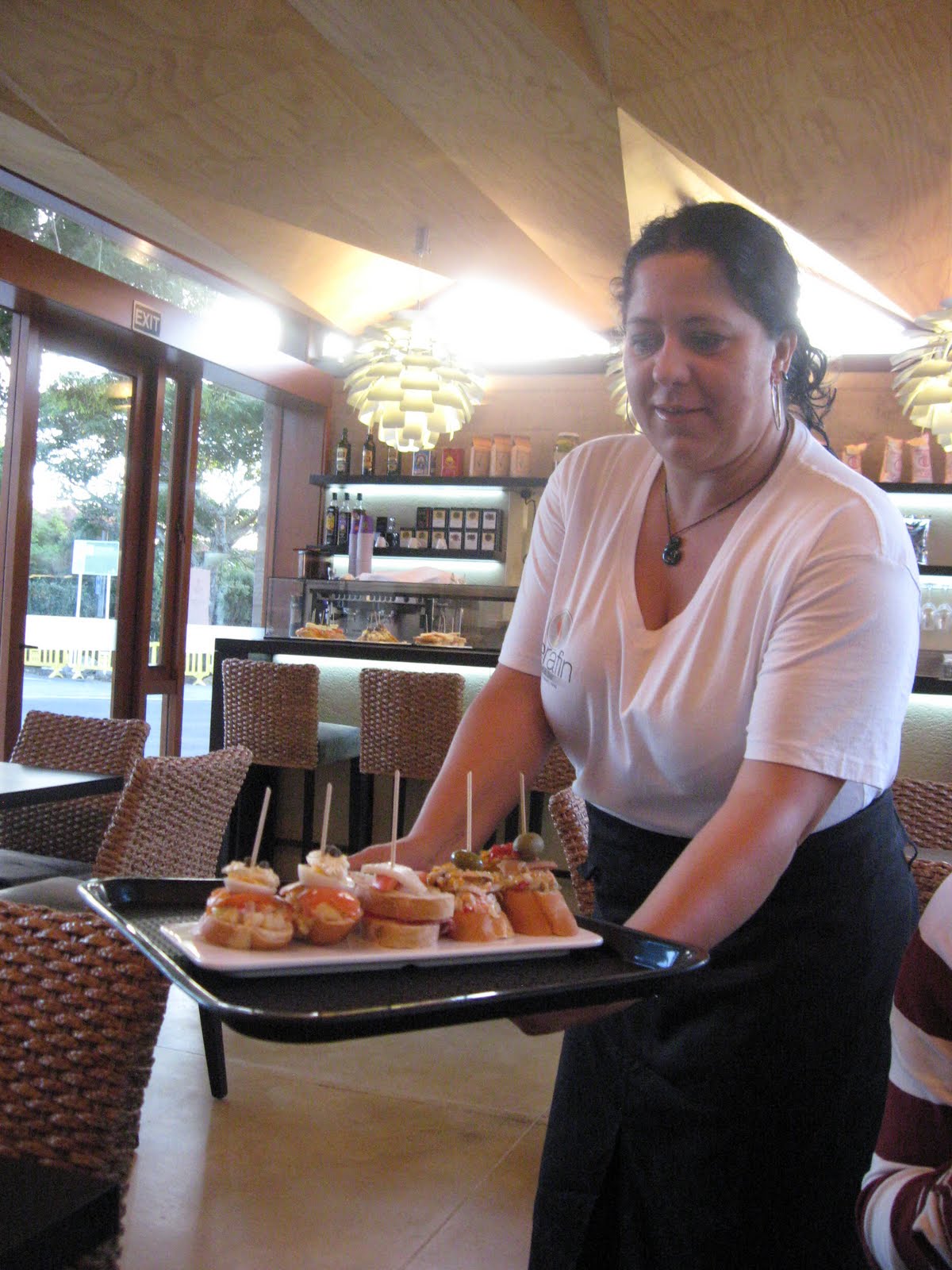
The first time we entered Serafin (presumably named after chef owner Serafin Bueno, who according to Lauraine Jacobs was "the talented Spanish chef who presided over the kitchen of The Regent Auckland hotel back in the 80s"), there were no other customers in the stylish eatery.   The welcoming staff greeted us in Spanish, explained to us what tapas were, somewhat unnecessarily, and offered us drinks and pinchos, which were morsels on slices of bread.  Apparently, the lack of a liquor licence has caused some customers to walk out, and we made sure we signed the petition for it (already with hundreds of names) after our meal, which turned out to be delicious.  It was heartening to see the room fill up somewhat by then too.

Waitress offering us a selection of pinchos
The waitress recommended the paella, and we chose to try the one with clams and prawns, along with various tapas.  It was as tasty as it looked, with a strong seafood flavour, far superior to the paella you can buy at the markets around Auckland.  A plate of bread with tomatoes appeared at our table, and we were wondering if our order was mixed up somehow, before we were told that people always ate tapas with this bread.

Arroz Meloso de Langostinos y Almejas, which we called the seafood paella
Also recommended: Bomba de Chorizo con Salsa de Mojo Verde
The desserts brought us especial delight, and we turned up one weeknight (empty restaurant again) simply for the freshly-made churros with creamy tasting dipping chocolate and the "very Spanish" dessert of torrijas, which is a bit like bread and butter pudding but is made with red wine.  We returned for a third time in two weeks with friends in tow (restaurant fuller on a weekend), and finally tried the crema catalana, which almost surpassed the previous fantastic desserts with its smooth custard and delicate lemon flavour.

Chocolate con churros

Torrijas, topped with vanilla icecream
In short, bring your friends for a meal at Serafin, and make sure you leave room for dessert!  You can practise your Spanish while enjoying the beautiful interior decor or the outdoor courtyard area, and we just know this little place is going to be chock-a-block full during the Rugby World Cup.

Panda Recommends

Tapas: Bomba de Chorizo con Salsa de Mojo Verde (Potato balls with chorizo and Mojo Verde sauce, $10.00)
Mains: Arroz Meloso de Langostinos y Almejas (Spanish rice casserole with prawns and clams, feeds two people, $42.50), Doble Cocion de Pato com Lentejas y Paprika Ahumada y sus Verduritas (two ways of cooking duck confit with lentils, smoked paprika, vegetables and sherry vinegar, $21.00), Chilindron de Cordero y Judias Blancas y Cebolla Tierna (Lamb rack casserole with white beans, amontillado sherry and baby onions, $21.00)
Desserts: Crema Catalana (Catalan baked custard, $9.50), Chocolate con Churros (Spanish doughnuts with chocolate sauce, $8.00), Torrijas (marinated bread in red wine, $10.00)

Vegie Pandas
Limited range of main items for vegetarians here, but the desserts are divine.

[Added 17 August 2011:

The menu below is out-of-date. In their updated menu, they have added a marinated salmon dish, and offer a full drinks selection, including Sangría for $9 a glass.  Prices have been revised upwards for some dishes but not for others, which is not a terrible thing as they used to be almost too cheap for the quality of food we were getting, and more people eat here now than ever before.
]
Menu
[Removed 16 July 2011:

Note

Currently you cannot purchase alcohol from this restaurant, but hopefully they will get a liquor licence soon, after the hearing which will be in Wellington on May 19.

]

Restaurant Details

Serafin Cafe & Bar
225B Dominion Road, Balmoral, Auckland
(09) 630 0228
buenoskitchen@gmail.com

Opening hours - winter (updated 29 June 2013):
Mondays closed.
Tuesdays to Thursdays 5:30 - 10pm
Fridays to Saturdays 11:30am - 3pm, 5:30 - 10pm
Sundays 11:30am - 3pm

Serafin opens onto Walters Road, off Dominion Road, next to the Wendy's drive-thru entrance.


View Nom Nom Panda in a larger map

Tuesday, March 29, 2011

Prickly Palusami @ Pasifika 2011

I have had very little to do with Polynesian cuisine so far, so I was excited to discover a couple of weeks ago that the Pasifika Festival was on.  With lots of stalls and performance areas clumped in "villages" around the beautiful Western Springs park, there was plenty of opportunity to try new foods and generally have a great day.

One of the "villages" by the lakeside

For me, practically everything was a novelty—from the 'ota 'ika (raw fish salad in coconut cream), pork buns and pani popo (buns in coconut milk sauce) which my friends went for—to the curry on cassava, pisua (a tapioca dessert which tasted of butterscotch) and pani keke ("banana pancake", more like deep-fried spherical donuts to me) which I tried—to the curiously-named items that we giggled at but did not manage to sample, like poke (Hawaiian raw fish salad) and 'otai (fruit drink with coconut milk).  Sapasui (chop suey mainly made with Chinese vermicelli, a.k.a. bean thread or glass noodles) and watermelon icecream also seemed to be very popular.

Watermelon icecream
What was for me the most memorable dish though, was the palusami (coconut cream and onions wrapped in taro leaves).  I was particularly curious about this as I had just read Jeffrey Steingarten's terrible reaction to eating food served on a raw taro leaf garnish in his book It Must Have Been Something I Ate.  I had also tried patra or alu vadi (taro leaf rolls) at one of my favourite Indian restaurants, Ras Vatika, which I enjoyed.  I simply needed to try taro leaves in another delicacy.

My first reaction was that it was delicious.  With coconut cream and savoury onions, the spinach-like packet was very tasty indeed.  As I ate though, I began to feel a prickling sensation in my mouth.  By the time I got to halfway through the palusami, it was actually painful.  Fortunately, unlike Steingarten, my breathing was not affected; but suffice it to say, I had difficulty convincing anyone else to try palusami from another stall.

Half-eaten palusami
Is this feeling normal from a prepared dish?  Is it bad for you?  Everything I have read suggested it was perfectly safe to eat cooked taro leaves, and my palusami certainly looked thoroughly cooked.  The acridity in raw taro is caused by raphides, or needle-like crystals, of calcium oxalate, which are located near stores of protein-eating enzymes, creating what Harold McGee calls "poison-tipped darts" in his book On Food and Cooking: The Science and Lore of the Kitchen.  According to him, cooking breaks down the plant's defence system by "denaturing the enzymes and dissolving the crystals."  Could it be that my palusami simply wasn't cooked enough, even though it looked limp?

I haven't completely worked it out yet, but from what I gather from the Taro Wikispaces page, it's not so much the insoluble oxalates such as calcium oxalate which you should be worried about.  These pass through your system, while the soluble oxalates (which also exist in taro leaves) are easily absorbed and can lead to kidney stones.  You want to boil your leaves (or apply some other moist heat treatment) and throw away the water to reduce the soluble oxalate levels.  You can also eat your taro leaves with a calcium-rich food like milk so that insoluble calcium oxalate salts get formed, thus reducing oxalate absorption.

After reading the sections on Elephant Ear (a close relative of taro, with large leaves) and Taro in the book Poisonous Plants of Paradise: First Aid and Medical Treatment of Injuries from Hawaii's Plants by Susan Scott and Craig Thomas, it occurs to me that I may have eaten a specimen of the plant that simply cannot be made edible by any amount of cooking.  Perhaps cooks would do well to heed the advice shared on Elaichi et Cetera: "A tip from Vee of Past, Present and Me: break the stem of an arbi [a.k.a. taro] leaf you intend to use, rub the juice on your inner wrist and count to ten; if it stings, the oxylate concentration is too high. Don’t use them."

Thursday, February 24, 2011

Serendipity

Every time you go out to eat, you are in search of a wonderful meal.  But sometimes, just sometimes, you come across something that you have not seen anywhere else before, something different and exciting.  Below are some foods that I have been surprised by, mainly pleasantly.

Polenta Chips

I love eating hot potato chips, so when I saw polenta chips on the menu at Coco's Cantina, I had to order some for comparison, even if it meant downgrading to an entrée for dinner.  I was not disappointed.  The long chunky chips were fragranced with rosemary, and stayed crisp and hot for much longer than you would expect.  They were absolutely delicious with or without the accompanying aioli. Just be careful you don't burn your tongue!

Polenta chips with aioli
Available for $8.50 at
Coco's Cantina
376 Karangahape Road, Newton, Auckland
(09) 300 7582
Turesdays to Saturdays 5pm - late

Feijoa Cider

Just up the road at the Wine Cellar, a basement bar in St. Kevins Arcade on K'Rd, I tasted feijoa cider for the first time when a friend played a gig there nearly a year ago.  Not only was it a proper cider rather than feijoa mixed with wine, it also came on tap.  It was fruity and intoxicating, and absolutely the best cider I have ever had.  Made from organic feijoas from Purangi, it tasted different every time I returned.  It was not always available, and it was never as good as I remembered again (sometimes it had a bitter aftertaste, more like beer) but I still go back once in a while to see if I can taste the most fantastic cider again.

Available (call first to make sure) for $7 a glass or $9 a pint at
Wine Cellar
St. Kevins Arcade, 183 Karangahape Road, Newton, Auckland
(09) 377 8293

Chirimoya Juice

I had never even heard of chirimoya before seeing its juice offered at Mexican Specialties.  This South American fruit (I bought a whole one to admire, and the chef picked out a ripe one for me that was ready to be eaten that very day) is related to the custard-apple, and looked green and scaly.  The juice was sweet, with a tropical flavour.  It wasn't available last time I visited the restaurant, so I am guessing it is out of season (I had it a couple of years ago, around October), but with other items on the drink menu such as cold chocolate, tamarind juice, pineapple and coconut, and lemon and lime, I wasn't about to complain.

Mexican Specialties
92 Marua Road, Ellerslie, Auckland
(09) 580 2497
Thursdays and Fridays 11am - 3pm
Saturdays 10am - 4pm

Sweet Masala Pan

Having studied Latin throughout high school, I could only associate the word pan with bread.  In India, this word means nothing of the sort.  Pan, or paan, refers to the betel leaf, which is commonly used to wrap a an assortment of fillings.  The sweet variety does not contain tobacco, and the lady at Ras Vatika assured me that this would be refreshing and good for the digestion.  As I was feeling full from dinner and wanted to find out more about this novelty (I hesistate to call it a dessert, even though it is sweet and eaten after dinner), I took one of these little green packets home.

As I was completely clueless about sweet masala pan, I decided to do some web research.  Were you supposed to eat the packet whole, leaf and all?  Were you supposed to chew and spit, or actually swallow the thing?  What is this betel business anyway?  What I discovered put me off altogether.  Apparently, the areca nut, commonly known as betel nut, which was listed as one of the fillings of my pan, can cause oral cancer.  Now, I know that there are a gazillion things in the world which can give you cancer, including burnt toast, but that doesn't mean I want to take my chances.

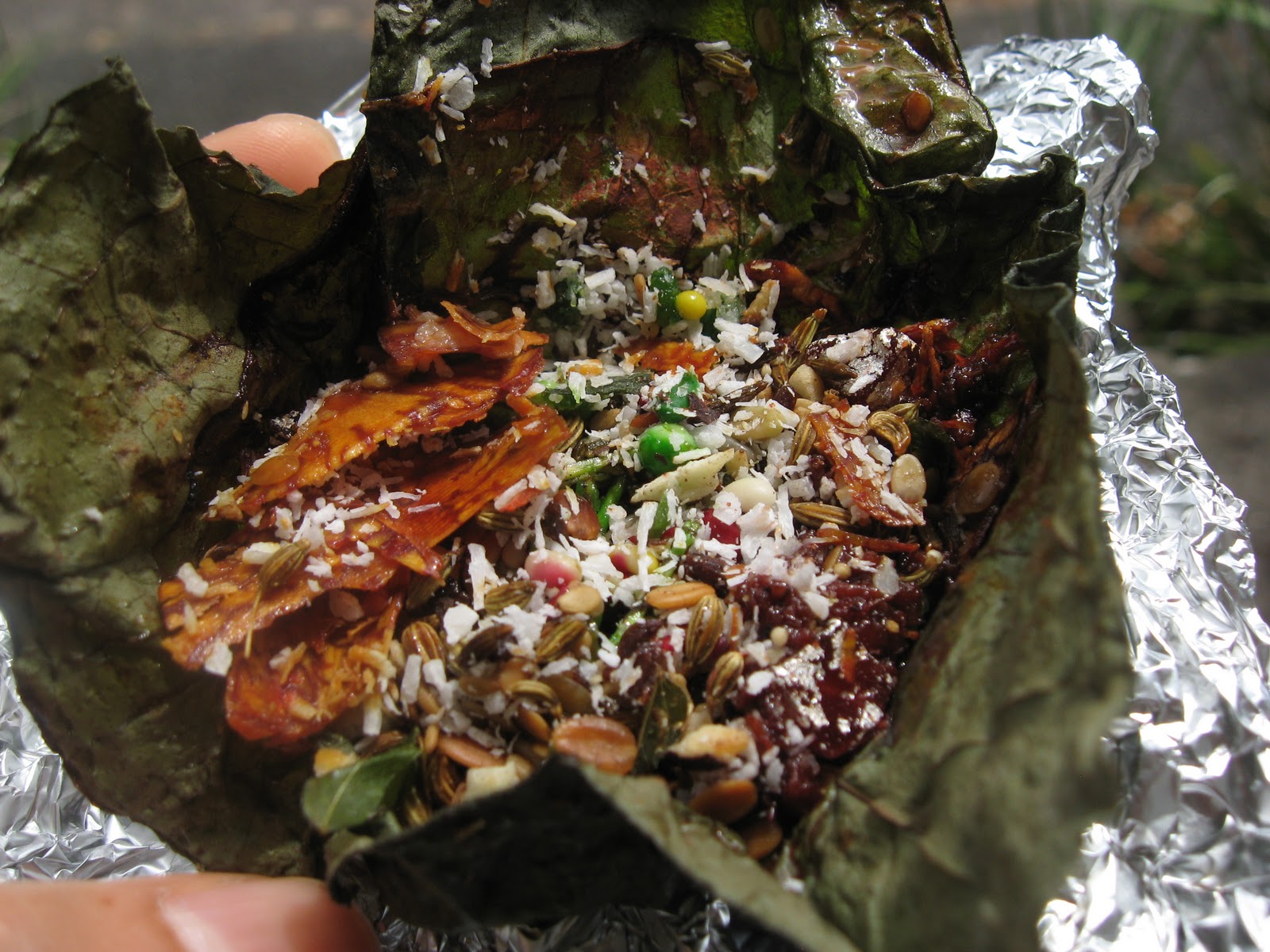
By the time I plucked up the courage to try some meetha pan, I had left the thing in the fridge so long that the leaf was shrivelled up and more unappetising than ever.  Cautiously, I opened up the leaf wrapper, to investigate the contents.  It smelt of mint and rose, and I saw dessicated coconut, fennel seeds, unidentified coloured candies, a reddish brownish sauce and some bark-like sheets that I assumed was the areca nut.  I admit that I only had the tiniest ever little pinch of the filling, but it tasted as it smelt, of menthol and flowers.  I may give it a proper go some day, but I suspect this is one of those things that may be an acquired taste.


Sweet masala pan, with the betel leaf opened up
Ras Vatika
596 Dominion Road, Balmoral, Auckland
(09) 623 2145
Mondays closed.
Tuesdays to Sundays 11:30am - 10pm

Monday, January 31, 2011

Review: O'Sarracino *CLOSED*

[Added 28 January 2015: O'Sarracino has announced that it is turning into IKA Seafood Bar and Grill.]

My favourite Italian restaurant in Auckland doesn't serve pizza. And although I consider it fine dining, it doesn't have the restrained formal atmosphere you associate with many restaurants; it is a place for loud and raucous eating, to share with friends.  Even before it was named the winner of Cuisine magazine's Best Specialist Restaurant award in 2010, we knew it was special.

The first few times we ate at O'Sarracino, we were given samples at the slightest suggestion of interest: two types of cheeses one time, and a digestif similar to limoncello another time.  The restaurant was beautiful, with polished wooden floors and stained glass windows left over from the days when the building was, ahem, a funeral parlour.  The reason we kept coming back, though, was for the food, which was unlike anything we had eaten before in other Italian restaurants.

You simply cannot go to O'Sarracino without trying the antipasti platters.  We have never ordered dishes one by one, instead asking the waiter to bring out a selection of the specialties, which are always just right in terms of size and taste.  Where else would you go for something like casatiello, hand made bread with salami, pancetta and cheese rolled inside?

Antipasti: cured meats and bread, casatiello with crumbed eggplant, insalata caprese, vegetables Naples style, bruschetta, and insalata di mare
The pasta dishes are fantastic as well, fresh and tasty, and probably the best you can get in Auckland, with the pasta made daily by an Argentinian man who ran the Pasta La Vista shop that used to be next door (unfortunately the store closed in August 2009, but I was told that manufacturing would continue in the outskirts of Auckland).

A selection of pasta, meat and seafood mains selected by our waiter
If you still have room, you will want to try the desserts as well, which is a changing menu.  One friend was very disappointed when tiramisu was not available when we went, but when I last dined at O'Sarracino, I managed to try it, a big blob of creamy goodness on a plate.  On that occasion though, my favourite was the panettone, a dryish fruit loaf with a delicate citrus flavour that went perfectly with icecream.

Desserts of the day: chocolate pot, tiramisu, panettone with icecream, and panna cotta
It won't be a cheap dinner, but all in all, O'Sarracino is a great choice for a special birthday (let the waiter know so they can dim the lights and sing you a birthday song), or for catching up with friends.  Buon appetito!

Panda Recommends

Antipasti platters, pastas, basically anything the waiters recommend!  Allow at least $60 per person.

Vegie Pandas
Ask and you shall receive.

Food menu
Note

Bookings required.  Going with a larger group will let you try more dishes.

Restaurant Details

O'Sarracino
3-5 Mount Eden Road, Eden Terrace, Auckland
(09) 309 3740

Opening hours:
Tuesdays to Saturdays 6:30pm till late.

O'Sarracino is on Mount Eden Road, close to the intersection with Symonds Street

Sunday, December 19, 2010

Feeling Foreign

Auckland is a fantastic place for eating authentic Asian food.  It's hard to get the authentic experience though, if you are with people that don't look like the right ethnicity, or if you don't speak or read the language.  I am thinking in particular about a number of Chinese restaurants that I have been to recently.  It's a rude shock to the system when, instead of being asked which kind of tea you would like, you are offered soft drinks and beer.  At a Malaysian restaurant, we even had to ask for chopsticks, which had been given to other tables by default.  Then there are the specials which appear on untranslated signs, which no doubt contain items of exceptional interest, perhaps because they are things you can't normally get, or perhaps because a discount is in effect.  Long story short, although I love eating out at the various ethnic restaurants, I almost always feel like I am somehow missing out.

Sometimes it's not even enough to look right and to speak and read the language.  Some things you just have to know.  The other night, at a large family dinner, I was offered a 15% discount at a Chinese restaurant, which as far I know, was not advertised anywhere.  Against my mother's advice, I asked if I could pay by credit card, fully expecting a negative answer.  Instead, the lady paused, nodded, and proceeded to swipe my card through.  It was not until I checked the receipt afterwards that I realised this meant I did not receive the discount, which came to nearly $20.  Not the end of the world, but it's embarrassing when you pass it over in favour of what comes out to be $1.33 in reward points.

So, what's one to do?  If you don't have a "local" in your group, is it still possible to order special items, receive those free soups and desserts?

Monday, November 29, 2010

Nutty About Nuts

I love nuts.  Whole walnuts, freshly removed from their shells; boiled peanuts in Chinese soup; roasted chestnuts, hot from a street seller; the delicate fragrance of cashew butter—you name them, I love them.  Recently, a workmate introduced me to a new way of eating nuts, more specifically, eating raw almonds that have been soaked in water overnight.  Their texture becomes different, kind of springy rather than crunchy, and the skins just peel away effortlessly.  They taste sweeter too, without the mildly bitter brown skin.  I bet my parents would be able to make a really nice almond milk using these soaked and peeled almonds, creating a smooth and silky drink like their cashew milk, rather than their usual gritty almond milk.  The only thing I wonder about is whether I am missing out on valuable nutrients by not eating the skins, and not drinking the slightly cloudy water that I pour away.  For the refreshing flavour and texture combination though, I can definitely recommend trying this sometimes.

Natural almonds (left) and soaked and peeled almonds (right)

On the subject of nuts, and since it is getting close to Christmas time, I was wondering why those bags of unshelled nuts contain the nuts that they do, usually walnuts, almonds, brazil nuts and hazelnuts.  (As an aside, isn't English curious, since shelled nuts are the ones with the shells removed and unshelled nuts are the ones with the shells.  Also, apparently almonds, cashews, macadamias, peanuts, pistachios and some others are not true nuts in a botanical sense—in fact, only hazelnuts in my previous list would be classified as a nut.)  You can remove the shells of roasted peanuts and pistachios fairly easily, without special implements, while macadamias are probably not included in those bags of nuts because they would break your nutcracker rather than the other way round.  But why have I never seen a cashew nut in its shell?

It turns out that cashew nuts have a toxic shell.  And though I had never heard of it before, the fruit of a cashew tree, called the cashew apple, is actually edible, with a strong smell and sweet taste.  Some people even make alcohol from it!  Whatever next?

[Added 26 January 2011:

Tried to make my own almond milk the other day, after first blanching raw almonds in just-boiled water for one minute to remove the skins.  No matter how little water I added before blending the nuts, I couldn't seem to get a strong almond flavour, even after straining out the distracting gritty pulp.  Internet researched solved the mystery for me: the intense flavour from almond essence is actually produced from the oil of bitter almonds, not the sweet almonds you normally eat.  Eating bitter almonds could kill you though, as they contain amygdalin and the enzyme emulsin, which together in the presence of water produces cyanide.  I guess that's why I've never seen bitter almonds for sale in the supermarket!
]
Related Posts Plugin for WordPress, Blogger...